
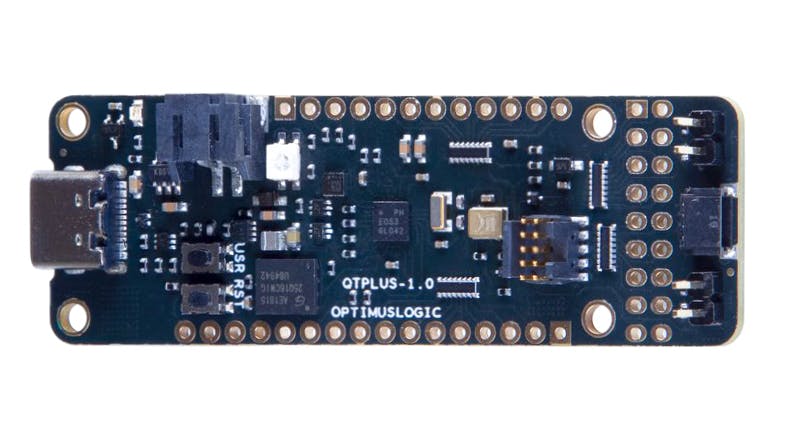
 QuickLogic Corporation announced that it is co-launching the new SparkFun Thing Plus – QuickLogic EOS S3 development kit, featuring a small form factor board with a QuickLogic EOS S3 SoC with Crowd Supply and SparkFun Electronics. This new dev kit includes the Qwiic Connect System enabling users to easily complement the embedded FPGA and MCU on the EOS S3 SoC with a multitude of additional development functionality. It’s also fully supported by open source development tools, making the kit highly accessible to everyone from students to consultants to engineers at the world’s largest corporations.
The SparkFun Thing Plus – QuickLogic EOS S3 development kit incorporates the EOS S3 SoC, which includes QuickLogic’s embedded FPGA (eFPGA) technology with 2,400 effective logic cells and 64 KB of RAM along with an embedded Arm Cortex-M4F MCU running at up to 80 MHz and providing 512 KB of RAM. The eFPGA technology can implement custom IP, accelerate or offload functions from the MCU, or provide glue logic. The Arm Cortex-M4F can implement functions generally best suited to the software. This extreme hardware and software flexibility makes the kit a perfect development platform for a wide range of applications, including adding voice or AI/ML processing to edge IoT devices. A further benefit of combining embedded FPGA and MCU functionality on the same SoC is that the EOS S3 consumes very little power – making it suitable for remote and battery-powered applications.
SparkFun’s Thing Plus – QuickLogic EOS S3 form factor and integrated Qwiic Connect System enables developers to easily add other design building blocks to the Thing Plus – EOS S3 dev kit, including over 150 development boards, sensors, LCDs, relays, and more, without the need for soldering. Once the boards begin shipping at the end of May, SparkFun will release its standard suite of documentation, including sample code, design files, and tutorials for getting started. The kit is supported by 100% open-source software tools such as FreeRTOS, Zephyr, nMigen, Docker, and SymbiFlow, and includes out-of-the-box support for AI tools, including the SensiML Analytics Toolkit and TensorFlow Lite. The development kit will be sold and distributed through the online site, Crowd Supply, further increasing its accessibility.
The SparkFun Thing Plus – QuickLogic EOS S3 development kit has launched exclusively on Crowd Supply.





Leave a Reply