The ALT1350 is the world’s first cellular LTE-M/NB-IoT solution to enable additional LPWA communication protocols, as well as satellite connectivity (NTN), in a single chipset, opening the door to further innovation in the connected world.
The ALT1350 by Sony is the most advanced cellular IoT solution on the market, with an architecture that resolves IoT service providers’ power consumption concerns. Its optimized standby mode 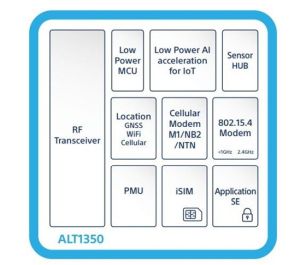 (eDRX) reduces power consumption by 80% when compared to the current generation and by 85% when using it to send short messages. Overall improvements in the system’s power consumption will enable four times longer battery life for a typical device, enabling additional functionalities and use cases with smaller batteries.
The ALT1350’s sub-GHz and 2.4GHz integrated transceiver enables hybrid connectivity for smart meters, smart cities, trackers, and other devices. This enhances coverage, reduces costs, and further decreases power consumption utilizing IEEE 802.15.4-based protocols, such as Wi-Sun, U-Bus Air, and wM-Bus, in additional point-to-point and mesh technologies.
ALT1350 incorporates a sensor hub to collect data from the sensors while maintaining ultra-low power consumption. It also provides cellular & Wi-Fi-based positioning and is tightly integrated to provide power-optimized concurrent LTE and GNSS to accommodate various tracking applications, which can be demanding, with a single chip.
“The market demand for this multiprotocol, ultra-low power IoT chipset is intensifying, and Sony’s ALT1350 chipset meets that demand,” said Nohik Semel, CEO at Sony Semiconductor Israel. “This is the game changer we’ve been waiting for, which will enable IoT deployments, utilizing universal connectivity on edge processing and multiple location technologies”
The chipset is designed to support the wide-ranging market needs of utilities, vehicles, tracking devices, smart cities, connected health, and other verticals. Device manufacturers across all verticals will take advantage of its low power consumption, long-lasting battery life, mature Release 15 LTE-M/NB-IoT software stack, and future compatibility with 3GPP release 17 All these guarantee longevity and ensure the ALT1350 will operate with 5G networks. It contains an additional LPWA radio transceiver with targeting operation in <1GHz and 2.4 ISM bands for universal connectivity options.
The chipset provides advanced on-the-edge low-power processing capabilities, ranging from data collection, low-power AI/ML processing of the data, and MCU to enable IoT applications on the chip. Currently, the device is sampling to lead customers and will become commercially available during 2023. The ALT1350 also includes a secure element for application usage and integrated SIM (iSIM), designed for PP-0117 to meet GSMA requirements.
Sony Semiconductor Israel, 59 Washington St #109, Santa Clara, CA 95050, 408.666.7551, www.altair-semi.com