
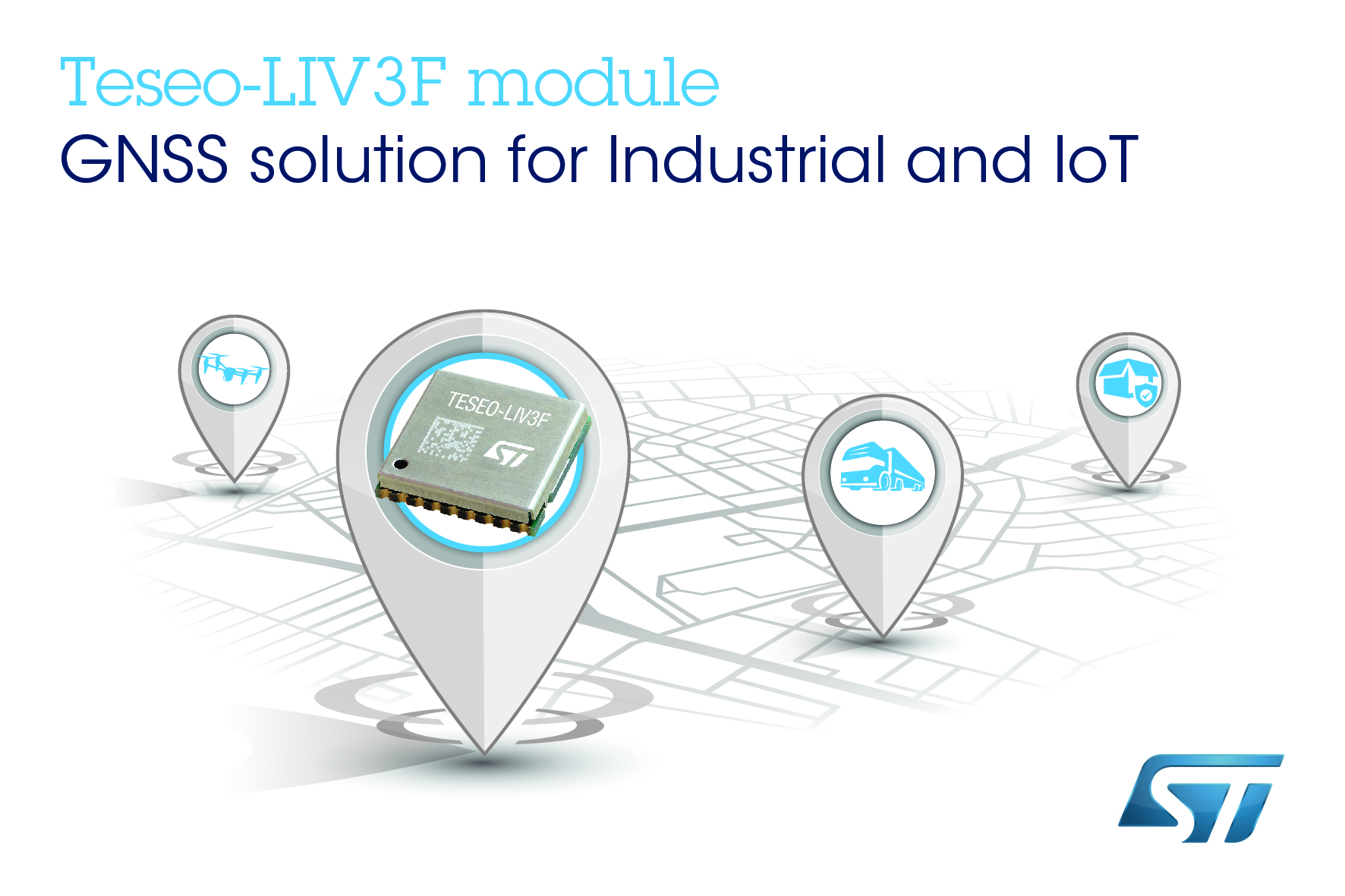
 STMicroelectronics is making its Teseo III satellite-navigation receiver accessible to a wider designer community by introducing the Teseo-LIV3F module, which integrates essential features to speed application development and also adds up to 16Mbit of Flash memory for firmware updating or data logging without a backup battery.
Highly regarded by experts in automotive and industrial sectors, ST’s Teseo III multi-constellation receiver combines high accuracy with fast response time and low power consumption. The Teseo-LIV3F module now enables makers and small engineering teams without extensive in-house RF expertise to leverage the Teseo III advantages in creating new products in the industrial and consumer market segments like vehicle trackers, drones, anti-theft devices, pet locators, and systems for services such as fleet-management, tolling, vehicle sharing, or public transportation.
The easy-to-use 18-pin, 9.7mm x 10.1mm module contains the Teseo III receiver with on-chip power management, UART and I2C interfaces, alongside the Flash memory, an ultra-stable temperature-controlled crystal oscillator (TCXO), and 32kHz real-time clock (RTC). The documentation and tools delivered with the module contain all the C code needed to drive the module using the STM32 microcontroller, including the use of data-logging, odometer, and geo-fencing to aid development of value-added functionality.
While simplifying application development, Teseo-LIV3F delivers high performance, including -163dBm tracking sensitivity and 1.5m positioning accuracy (CEP[1]) and low-power operation (17µW in standby mode and 75mW when tracking). FCC and CE certifications streamline product testing and accelerates time to market.
Multi-constellation flexibility ensures robust, failure-resistant navigation worldwide, with access to GPS, GLONASS, Galileo, and Bei Dou constellations, as well as the Pacific-region Quasi-Zenith Satellite System (QZSS). The module supports assisted modes including autonomous ST Assisted GPS® (STAGPS®) and Server-Based Assisted-GNSS with free server access, to retrieve ephemeris data if satellites are unavailable for fast TTFF (Time To First Fix). There is also support for standardized augmentation systems to enhance accuracy, including the US, European, Japanese/South-East Asia, and Indian Satellite-Based Augmentation Systems (SBAS), and the Radio Technical Commission for Maritime Services (RTCM) differential GPS.
The Teseo-LIV3F module is available now as an 18-pin LLC device.
For further information please visit http://www.st.com/gnss-modules-nb.

Leave a Reply