
• Skip to primary navigation
  • Skip to main content
  • Skip to primary sidebar
  • Skip to footer

Microcontroller Tips

Microcontroller engineering resources, new microcontroller products and electronics engineering news

  • Products
    • 8-bit
    • 16-bit
    • 32-bit
    • 64-bit
  • Applications
    • 5G
    • Automotive
    • Connectivity
    • Consumer Electronics
    • EV Engineering
    • Industrial
    • IoT
    • Medical
    • Security
    • Telecommunications
    • Wearables
    • Wireless
  • Learn
    • eBooks / Tech Tips
    • EE Training Days
    • FAQs
    • Learning Center
    • Tech Toolboxes
    • Webinars/Digital Events
  • Resources
    • Design Guide Library
    • LEAP Awards
    • Podcasts
    • White Papers
  • Videos
    • EE Videos & Interviews
    • Teardown Videos
  • EE Forums
    • EDABoard.com
    • Electro-Tech-Online.com
  • Engineering Training Days
  • Advertise
  • Subscribe

High-Speed CAN Transceivers Are Low
Power and Highly Robust

June 24, 2013 By Nika Sedghi Leave a Comment

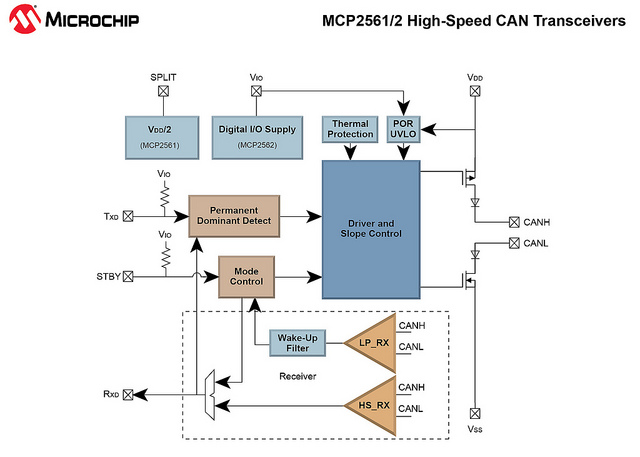
The new family of High-Speed (HS) CAN transceivers like, the MCP2561/2.  These new devices serve as an interface between a CAN protocol controller and the physical two-wire CAN bus.  The new family of transceivers meet CAN specification requirement “GIFT ICT Group Conformance Test Specification V1.0” as verified by C&S Group GmbH in addition to other global automotive Electromagnetic Compatibility (EMC) requirements such as “Hardware Requirements for LIN, CAN and FlexRay Interfaces in Automotive Applications,” Version 1.3, May 2012 as verified by IBEE.  Users can have confidence in CAN conformance and high robustness increasing ease of development and system reliability.

The new family of MCP2561/2 transceivers provides two device options.  The MCP2561 is an HS CAN transceiver in an 8-pin package and features a SPLIT pin.  The SPLIT pin helps to stabilize common mode in biased split termination schemes.  The MCP2562 is also an HS CAN transceiver available in an 8-pin package and features a Vio pin.  The Vio pin can be tied to a secondary supply in order to internally level shift the CAN transceiver digital I/Os for easy microcontroller interfacing.  This is beneficial when a system is using a microcontroller at a Vdd less than 5V (for example, 1.8V or 3.3V) and eliminates the need for an external level translator decreasing system costs and complexities.

The transceivers have an industry low standby current consumption (<5 µA typical) helping meet automotive Electronic Control Unit (ECU) low-power budget requirements.  Both parts are also available in 8-lead PDIP, SOIC and 3×3 mm DFN (leadless) package types allowing for development flexibility and offering alternatives for space limited application boards.  Additionally, the devices support both Extended (E): −40°C to +125°C and High (H): −40°C to +150°C temperature ranges providing customers the ability to use one part across various CAN connected applications.

The MCP2561/2 CAN transceivers are well suited for a wide range of applications in the automotive market including power train, body and convenience, diagnostics, safety and security and the industrial market, including manufacturing, construction and agriculture, among other.
9101617127_a547e5069d_z
microchip_headLogo-1-copy
Microchip
www.microchip.com

Filed Under: Applications, Automotive, Industrial Tagged With: microchip

Reader Interactions

Leave a Reply Cancel reply

Your email address will not be published. Required fields are marked *

Primary Sidebar

Featured Contributions

Edge AI without the guesswork: designing for real battery life, real performance, and real workloads

Designing for functional safety in robotics: key considerations for engineers

Can chiplets save the semiconductor supply chain?

Navigating the EU Cyber Resilience Act: a manufacturer’s perspective

The intelligent Edge: powering next-gen Edge AI applications

More Featured Contributions

EE TECH TOOLBOX

“ee
Tech Toolbox: Aerospace & Defense
This Tech Toolbox dives into the technical realities of modern defense, exploring how MBSE is streamlining aerospace design and what’s next for radar and electronic warfare.

EE Learning Center

EE Learning Center

EE ENGINEERING TRAINING DAYS

engineering
“bills
“microcontroller
EXPAND YOUR KNOWLEDGE AND STAY CONNECTED
Get the latest info on technologies, tools and strategies for EE professionals.

Footer

Microcontroller Tips

EE World Online Network

  • 5G Technology World
  • EE World Online
  • Engineers Garage
  • Analog IC Tips
  • Battery Power Tips
  • Connector Tips
  • EDA Board Forums
  • Electro Tech Online Forums
  • EV Engineering
  • Power Electronic Tips
  • Sensor Tips
  • Test and Measurement Tips

Microcontroller Tips

  • Subscribe to our newsletter
  • Advertise with us
  • Contact us
  • About us

Copyright © 2026 · WTWH Media LLC and its licensors. All rights reserved.
The material on this site may not be reproduced, distributed, transmitted, cached or otherwise used, except with the prior written permission of WTWH Media.

Privacy Policy