Bryan Miller, MEN Micro
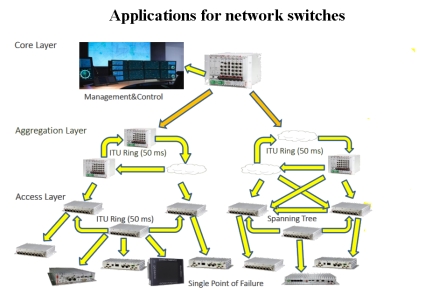
From big data in the cloud to smaller data pieces in the fog (such as device-to-device), one of the more important pieces of hardware that moves data is the network switching system itself.
Depending on where the data lives and where it needs to go, network requirements can vary greatly. Typical network switch requirements tend to involve four factors:
1. Whether there is a need for mission-critical systems that must be separated from non-critical systems.
2. Whether data goes over the Ethernet or just from one machine to another.
3. The other systems the switch network must communicate with.
4. The means of ensuring all data is sent where it needs to go, when it needs to be there.
There are four different types of network switches in common use. The unmanaged switch has no built-in management capabilities. Unmanaged switches are generally backward-compatible so they automatically adjust the speed of each port to match the ethernet speed of the device connected to it. Switches sometimes called plus or smart devices monitor network traffic and lets network admin staff manage security, perform traffic control, do static routing, and monitor outbound traffic, among other things. What are called fully managed switches typically also provide a command-line interface so network administrators can easily configure and deploy the switches in enterprise environments. It is also possible to find PoE versions of network switches which provide power over the ethernet cabling for powering IP phones and wireless access points.
There can sometimes be confusion surrounding the differences between a network switch, a network hub, and a router. Hubs pass each frame to all their ports. hubs have no way of distinguishing where each frame should be sent. The problem is the hub must share its bandwidth with all its ports. If multiple devices are broadcasting, the bandwidth must be divided among all the broadcasting systems, possibly degrading performance. In contrast, switches keep a record of the MAC addresses of all the connected devices. The switch uses this information to identify which system is sitting on which port so it knows where to send each frame without significantly degrading network response times. Finally, routers typically sit at gateways and transfer data from one network to another. Network switches may have router functions integrated in, and vice versa.
Partitioning
Firewalls and gateways need to sit between internal systems as well as in front of those parts that could interact with a larger cloud-based network. Configuration within the system can provide the appropriate access points to and from places on the network itself. And a TPM-enabled (Trust Platform Management) chip easily facilitates encrypted data storage and secure booting. A password-protected BIOS can provide additional anti-tampering protection, as does the security provided by white or blacklisting which prevents access from unauthorized applications.
Transmission
Communication
Reliability
Modern networking switch systems offer up to 25 Gigabit Ethernet ports and can use 29 Gbit/sec carrier-grade switch matrices. Concerns over data integrity may arise at these high throughput rates. But concern over reliability is generally not an issue when those systems are developed under quality management guidelines and are verified and thoroughly tested by the manufacturer. Networking switches are being built to handle the growing amounts of data that the IoT is generating.
In considering reliability, it is good to think about specific performance requirements the application needs, the environmental extremes (such as temperatures, humidity, dust, shock, vibration) the system is likely to see over its life, and whether the system will be easily accessible or in a fairly remote location.
Switch networking systems should be developed to withstand a wide range of temperatures and environmental impacts as well as severe shock and vibration. Industry standards, such as EN 50155 for railway and ISO 7637-2 for road vehicles, help set the bar for operating performance.
Modularity
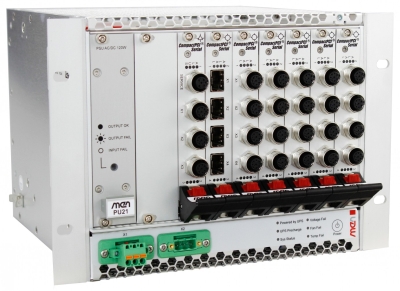
Although they integrate several functions, configurable network switches are highly customizable, able to match system requirements directly to application needs. The CPU can be swapped out for more processing performance if needed, and housings are made from a common construction, yet available in different sizes. I/O requirements can be implemented based on system need.
Maintenance
Fanless operation using conduction cooling is a given in any remote location but is also a possibility in more accessible environments. And systems that are pre-integrated significantly reduce installation efforts, while ensuring the unit will be operational in a short amount of time.

Leave a Reply