
Edge AI is no longer experimental. From wearables and medical sensors to smart home devices, industrial monitors, and infrastructure nodes, products are increasingly expected to sense, analyze, and make decisions locally while operating for months or even years on small batteries. This requirement has turned ultra-low-power system design into one of the most complex challenges […]
Featured Contributions
Designing for functional safety in robotics: key considerations for engineers
Robots are no longer confined to factory floors behind safety fences. Collaborative and humanoid robots now operate in direct proximity to people, shifting safety from a contained engineering problem to a system-level risk with real human consequences. Humanoid robots are currently being designed for use in public and semi-public spaces, such as warehouses, restaurants, and […]
Can chiplets save the semiconductor supply chain?

We’re making more semiconductors than ever before, and yet somehow, it’s still not enough. Demand is continuously increasing, spurred by the rise of AI in our everyday lives, but production still faces bottlenecks. The problem is more than just scale; it comes down to the structure of the manufacturing industry as a whole. As of […]
Navigating the EU Cyber Resilience Act: a manufacturer’s perspective

As connected devices proliferate across consumer, industrial, and automotive sectors, cybersecurity is becoming as fundamental to design as power efficiency or reliability. The European Union’s Cyber Resilience Act (CRA) introduces sweeping new cybersecurity requirements for connected products, creating both challenges and opportunities for electronics manufacturers and design engineers. This legislation will reshape how embedded systems and IoT […]
The intelligent Edge: powering next-gen Edge AI applications
Edge artificial intelligence (AI) technology is proving transformational for industrial enterprises as they shift focus toward the human- and planet-centric ideals of Industry 5.0. These solutions merge the power of edge computing with AI advancements to enhance efficiency, agility, and security through automation. They also reduce industrial reliance on centralized servers, helping to control both […]
Engineering harmony: solving the multiprotocol puzzle in IoT device design

In today’s connected world, IoT devices are asked to do more than ever — often serving as a bridge between cloud services, smartphones, and dense networks of local sensors. This requires a seamless combination of wireless protocols: Wi-Fi for high-throughput data and cloud connectivity, Bluetooth for mobile pairing and provisioning, and Thread or Zigbee for […]
What’s slowing down Edge AI? It’s not compute, it’s data movement

When building edge AI systems, engineers often assume compute is the primary bottleneck. But in most cases, it’s the inefficiencies of data movement between sensors, memory, and processors that dominate power and latency. This article explains why and how in-memory-compute architectures can help. Why your Edge AI chip falls short Most engineers deploying AI at […]
Five challenges for developing next-generation ADAS and autonomous vehicles

ADAS and autonomous vehicles need new datacom architectures and new attitudes. The state of California requires autonomous vehicle manufacturers to annually document and report every manual intervention by test drivers, including the cause and the vehicle’s mileage. In less than five years, these reports have demonstrated significant improvements in miles per intervention for virtually every […]
Securing IoT devices against quantum computing risks

The key to modern asymmetric cryptography is to create an equation that is easy to solve in one direction but difficult to reverse by an adversary in the other direction. Traditionally, this was done through modular arithmetic, where a large prime modulus and a generator were used to generate a key, although there are multiple […]
RISC-V implementation strategies for certification of safety-critical systems
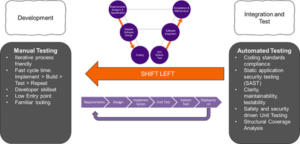
For developers using RISC-V-based platforms, the architecture offers unique features that can help achieve functional safety and security objectives. From its open architecture to a rich tools ecosystem, safety-critical software teams see benefits in meeting the guidelines of DO-178C and ISO 26262, for example, and opportunities to reduce compliance effort. Understanding how to map RISC-V’s […]
