
Marvell Technology, Inc. announced the successful interoperability of the Marvell Structera portfolio of Compute Express Link (CXL)with AMD EPYC CPUs and 5th-generation Intel Xeon platforms. This achievement underscores Marvell’s commitment to advancing an open and interoperable CXL ecosystem, addressing the growing demands for memory bandwidth and capacity in next-generation cloud data centers. Marvell collaborated with AMD […]
Accelerators
MCU features neural-ART accelerator for edge processing

STMicroelectronics is making embedded artificial intelligence (AI) truly here-to-help with a new microcontroller series integrating, for the first time, accelerated machine learning (ML) capabilities. This enables cost-sensitive, power-conscious consumer and industrial products to provide high-performance features leveraging computer vision, audio processing, sound analysis, and other algorithms, until now beyond the capabilities of small embedded systems. […]
Single-chip MPU bring vision AI to next-gen robotics
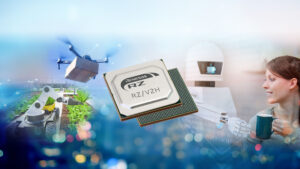
Renesas Electronics Corporation has expanded its popular RZ Family of microprocessors (MPUs) with a new device targeting high-performance robotics applications. Offering the highest levels of performance within the family, the RZ/V2H enables both vision AI and real-time control capabilities. The device comes with a new generation of Renesas proprietary AI accelerator, DRP (Dynamically Reconfigurable Processor)-AI3, […]
PCIe card accelerates edge AI workloads
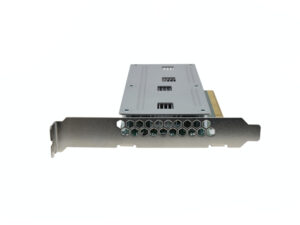
Lanner Electronics introduced the new PCIe AI Acceleration Card, Falcon Lite, powered by Hailo-8 AI processors. The Falcon Lite’s modular PCIe form factor provides a flexible solution for solution providers looking to accelerate edge AI workloads with deployment flexibility and power efficiency. The Lanner Falcon Lite PCIe AI Acceleration Card is designed to meet the soaring demand for […]
Optical NoC processor designed for domain-specific AI workloads
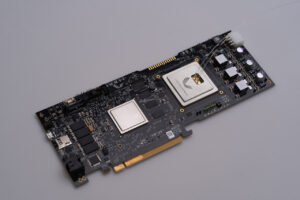
Lightelligence introduced a new big data interconnect paradigm with the launch of Hummingbird, the world’s first Optical Network-on-Chip (oNOC) processor designed for domain-specific artificial intelligence (AI) workloads. Hummingbird utilizes advanced vertically stacked packaging technologies to integrate a photonic chip and an electronic chip into one single package serving as the communications network for data centers […]
SoC with on-device learning AI accelerator targets edge IoT apps

ROHM Semiconductor announced they have developed an on-device learning[1] AI chip (SoC with on-device learning AI accelerator) for edge computer endpoints in the IoT field. The new AI chip utilizes artificial intelligence to predict failures (predictive failure detection) in electronic devices equipped with motors and sensors in real time with ultra-low power consumption. Generally, AI […]
MPUs feature built-in vision AI accelerator for image recognition, multi-camera image support

Renesas Electronics Corporation has expanded its AI-capable RZ/V Series of microprocessors (MPUs), with a new device that enables AI processing of image data from multiple cameras, offering a new level of highly accurate image recognition for vision AI applications. Equipped with two 64-bit Arm Cortex-A53 cores, the new device is capable of delivering high computing […]
Mini-ITX x86 system helps simplify embedded AI designs
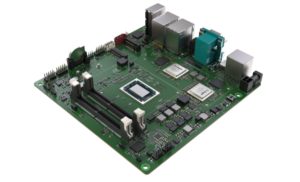
Flex LogixÒ Technologies, Inc. announced the InferXÔ Hawk – hardware and software-ready mini-ITX x86 system designed to help customers quickly and easily customize, build and deploy edge and embedded AI systems. The InferX Hawk system includes the Flex Logix InferX X1 AI accelerator chip, AMD Ryzen Embedded R2314 SoC, InferX Runtime software, and the EasyVision platform […]
Advanced graphics accelerator added to 32-bit MCUs

STMicroelectronics has released version 4.20 of its TouchGFX user-interface design software for STM32 microcontrollers. The latest updates include support for ST’s new NeoChrom graphics accelerator, which is integrated into advanced MCUs such as the new STM32U5 series. Developed from ST’s Chrom-ART Accelerator that manipulates pixels and shapes, NeoChrom allows full-screen rotation at any angle and supports […]
Accelerator cards support 400G Ethernet and PCIe 5.0
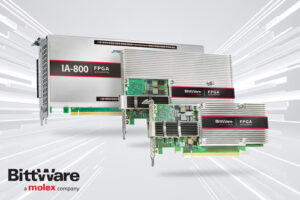
BittWare introduced new card and server-level solutions featuring Intel Agilex FPGAs. The new BittWare IA-860m helps customers alleviate memory-bound application workloads by leveraging up to 32GB of HBM2e in-package memory and 16 lanes of PCIe 5.0 (with CXL upgrade option). BittWare PCIe 5.0/CXL FPGA Accelerators feature Intel Agilex M-Series and I-Series to drive memory […]
