

IAR announced enhancements to its premier development environment to support the first general-purpose 32-bit RISC-V MCUs with Renesas’ internally developed CPU core. This enhanced offering includes advanced debugging capabilities and sophisticated compiler optimizations fully integrated with the Renesas Smart Configurator toolkit, design examples, rich documentation, and support for the Renesas fast prototyping board (FPB). As […]
Embedded
Compact SSDs support PCIe Gen 4×4 with enhanced data integrality and i-temp compatibility
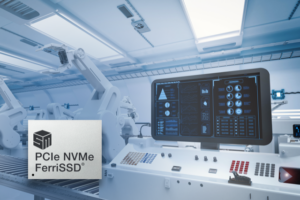
Silicon Motion Technology Corporation introduced the new generation FerriSSD NVMe PCIe Gen 4 x4 BGA SSD. This latest solution features support for i-temp and integrates advanced IntelligentSeries technology, delivering robust data integrity in extreme temperature environments that meet the rigorous demands of industrial embedded systems and automotive applications. The latest FerriSSD BGA SSD supports PCIe […]
RISC-V MCU group designed for diverse power-efficient applications
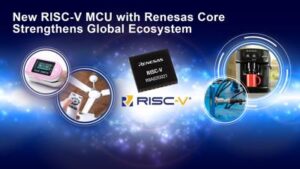
Renesas Electronics Corporation has introduced the industry’s inaugural general-purpose 32-bit RISC-V-based microcontrollers (MCUs) featuring an internally developed CPU core. While many MCU providers have recently collaborated in investment alliances to propel RISC-V product development, Renesas has independently designed and tested a new RISC-V core, now integrated into a commercial product available worldwide. The new R9A02G021 […]
Embedded GNSS IC enhances IoT positioning accuracy
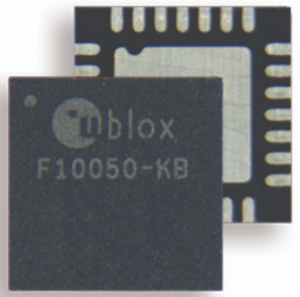
u-blox has announced F10, the company’s first dual-band GNSS (Global Navigation Satellite Systems) platform combining L1 and L5 bands to offer enhanced multipath resistance and meter-level positioning accuracy. The platform caters to urban mobility applications, such as aftermarket telematics and micromobility. Applications that use GNSS receivers for accurate positioning are on the rise. Yet, current […]
Computer-on-modules simplify embedded and edge computing integration
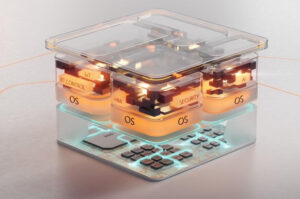
congatec has introduced the aReady.COM product family, the first stage of its innovative aReady. strategy. aReady.COMs offer significantly smoother implementation of embedded and edge computing technology by providing high-performance embedded building blocks, ranging from Computer-on-Modules (COM) to cloud. aReady.COMs integrate application-ready hypervisor, operating system, and IIoT software configurations that customers can customize to their requirements. […]
Industrial memory tokens from ATEK offer advanced reliability for industrial applications
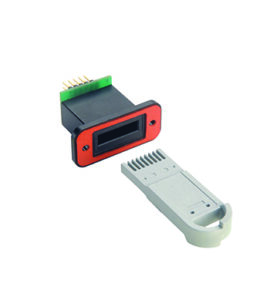
ATEK Access Technologies (ATEK) has expanded its Datakey RUGGEDrive™ lineup with the introduction of the Industrial UFX Series. This new series enhances the RUGGEDrive range by offering USB flash drive capabilities designed for industrial applications. It features operation across industrial temperature ranges and the option for pSLC NAND flash for enhanced reliability. The Industrial UFX […]
InterEdge spec released by PICMG to offer multi-vendor interoperability in industrial control

PICMG announced the release of InterEdge, a modular architecture for process control systems (PCS). The IEC 61499 and IEC 61131-compatible InterEdge specification promises to revolutionize the industry with an interoperable, multi-vendor alternative to proprietary Industrial PCs (IPCs), Programmable Logic Controllers (PLCs), and Distributed Control Systems (DCSs). InterEdge defines a vendor-neutral, open standard for edge computing […]
Low-cost, feature-reach SoC kit accelerates embedded and compute designs
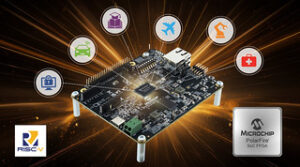
Microchip Technology has launched the PolarFire SoC Discovery Kit. By offering a user-friendly, feature-rich development kit for embedded processing and compute acceleration, Microchip is making emerging technology more accessible to engineers at all levels. The open-source development kit features a quad-core, RISC-V application-class processor that supports Linux and real-time applications, a rich set of peripherals, […]
High-speed, low-power embedded processor technology helps advance vision AI
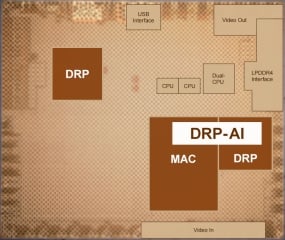
Renesas Electronics Corporation announced the development of embedded processor technology that enables higher speeds and lower power consumption in microprocessor units (MPUs) that realize advanced vision AI. The newly developed technologies are as follows: (1) A dynamically reconfigurable processor (DRP)-based AI accelerator that efficiently processes lightweight AI models and (2) Heterogeneous architecture technology that enables […]
Matter software libraries now available on xG24 kit and development board

Silicon Labs announced a new partnership in collaboration with Arduino to better enable the seamless development of Matter over Thread applications for Arduino’s 33 million-strong developer community. Developed in collaboration with Silicon Labs, Arduino’s first-ever Matter software libraries are available on both the xG24 Explorer Kit from Silicon Labs and the xG24-based SparkFun Thing Plus Matter – MGM240P development […]
