• Skip to primary navigation
  • Skip to main content
  • Skip to primary sidebar
  • Skip to footer

Microcontroller Tips

Microcontroller engineering resources, new microcontroller products and electronics engineering news

  • Products
    • 8-bit
    • 16-bit
    • 32-bit
    • 64-bit
  • Applications
    • 5G
    • Automotive
    • Connectivity
    • Consumer Electronics
    • EV Engineering
    • Industrial
    • IoT
    • Medical
    • Security
    • Telecommunications
    • Wearables
    • Wireless
  • Learn
    • eBooks / Tech Tips
    • EE Training Days
    • FAQs
    • Learning Center
    • Tech Toolboxes
    • Webinars/Digital Events
  • Resources
    • Design Guide Library
    • LEAP Awards
    • Podcasts
    • White Papers
  • Videos
    • EE Videos & Interviews
    • Teardown Videos
  • EE Forums
    • EDABoard.com
    • Electro-Tech-Online.com
  • Engineering Training Days
  • Advertise
  • Subscribe

Embedded GNSS IC enhances IoT positioning accuracy

March 19, 2024 By Redding Traiger Leave a Comment

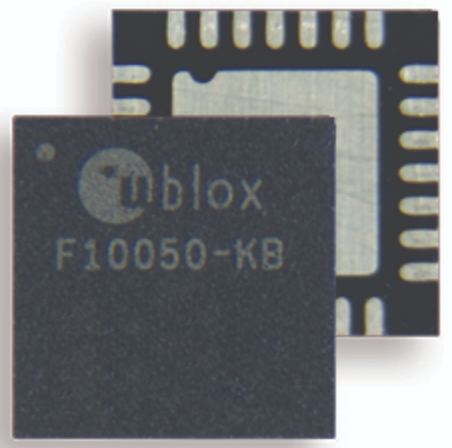
u-blox has announced F10, the company’s first dual-band GNSS (Global Navigation Satellite Systems) platform combining L1 and L5 bands to offer enhanced multipath resistance and meter-level positioning accuracy. The platform caters to urban mobility applications, such as aftermarket telematics and micromobility.

Applications that use GNSS receivers for accurate positioning are on the rise. Yet, current receivers do not fully perform in urban areas. Accurate and reliable positioning in dense urban environments, where buildings or tree foliage can reflect satellite signals, requires GNSS receivers to mitigate multipath effects. The L5 band’s resilience to these effects significantly improves positioning accuracy. Combined with the well-established L1 band, an L1/L5 dual-band GNSS receiver can deliver < 2 m positioning accuracy (CEP50), against about 4 m with the L1 band only. The u-blox team has conducted driving tests in several urban areas, confirming a significant improvement over GNSS L1 receivers.

The F10’s firmware algorithm prioritizes L5 band signals in weak signal environments, ensuring reliable positioning accuracy even when paired with small antennas. The platform is also equipped with protection-level technology that provides a real-time trustworthy positioning accuracy estimate.

When a cellular modem is extremely close to a GNSS receiver, it can interfere with the receiver’s reception. Some F10 module models (NEO-F10N, MAX-F10S, and MIA-F10Q) are equipped with a robust RF circuit that allows the GNSS and the cellular modem to operate without interference.

The u-blox F10 platform is pin-to-pin compatible with the previous u-blox M10 generation for easy migration. It also supports u-blox AssistNow, which offers real-time online A-GNSS service with global availability to reduce GNSS time-to-first-fix and power consumption.

The u-blox EVK-F101 evaluation kit will be available in April 2024.
You may also like:


  • What are the challenges when testing chiplets?

  • How can in-package optical interconnects enhance chiplet generative AI performance?

  • How do MCUs support automotive infotainment systems?

  • How do the seven types of V2X connectivity work?

  • What? LORAN may be back? Why? How? Part 1

Filed Under: Connectivity, Embedded, IoT, Products, receivers, Telecommunications, Tools Tagged With: ublox

Reader Interactions

Leave a Reply Cancel reply

Your email address will not be published. Required fields are marked *

Primary Sidebar

Featured Contributions

Can chiplets save the semiconductor supply chain?

Navigating the EU Cyber Resilience Act: a manufacturer’s perspective

The intelligent Edge: powering next-gen Edge AI applications

Engineering harmony: solving the multiprotocol puzzle in IoT device design

What’s slowing down Edge AI? It’s not compute, it’s data movement

More Featured Contributions

EE TECH TOOLBOX

“ee
Tech Toolbox: Connectivity
AI and high-performance computing demand interconnects that can handle massive data throughput without bottlenecks. This Tech Toolbox explores the connector technologies enabling ML systems, from high-speed board-to-board and PCIe interfaces to in-package optical interconnects and twin-axial assemblies.

EE Learning Center

EE Learning Center

EE ENGINEERING TRAINING DAYS

engineering
“bills
“microcontroller
EXPAND YOUR KNOWLEDGE AND STAY CONNECTED
Get the latest info on technologies, tools and strategies for EE professionals.

Footer

Microcontroller Tips

EE World Online Network

  • 5G Technology World
  • EE World Online
  • Engineers Garage
  • Analog IC Tips
  • Battery Power Tips
  • Connector Tips
  • EDA Board Forums
  • Electro Tech Online Forums
  • EV Engineering
  • Power Electronic Tips
  • Sensor Tips
  • Test and Measurement Tips

Microcontroller Tips

  • Subscribe to our newsletter
  • Advertise with us
  • Contact us
  • About us

Copyright © 2026 · WTWH Media LLC and its licensors. All rights reserved.
The material on this site may not be reproduced, distributed, transmitted, cached or otherwise used, except with the prior written permission of WTWH Media.

Privacy Policy