
A software platform facilitates autonomous vehicle design by capturing, fusing, and managing raw data in real time from a wide range of sensing modalities, including radar, LIDAR, vision and other sensors. Called the DRS360 platform, the software from the Siemens business unit Mentor Graphics is said to reduce latency, boost sensing accuracy, and improve overall system efficiency for SAE Level 5 autonomous vehicles.
The DRS360 platform directly transmits unfiltered information from all system sensors to a 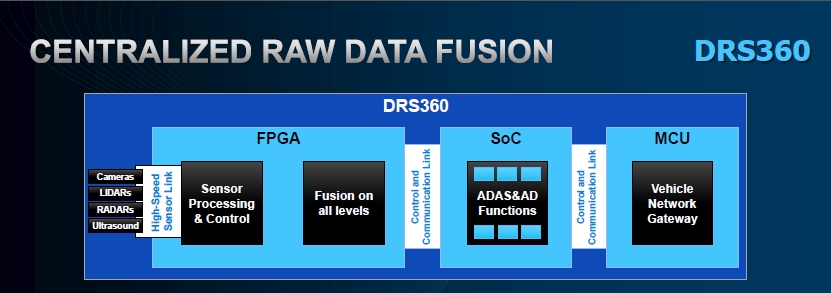 central processing unit, where raw sensor data is fused in real time at all levels. The platform employs “raw data sensors”, which are unburdened by the power, cost and size penalties of microcontrollers and related processing in the sensor nodes, in partnership with leading sensor suppliers. Eliminating pre-processing microcontrollers from all system sensor nodes is said to enable a broad array of advantages, including real-time performance, significant reductions in system cost and complexity, and access to all captured sensor data for the highest resolution model of the vehicle’s environment and driving conditions.
The platform’s streamlined data transport architecture is said to further lower system latency by minimizing physical bus structures, hardware interfaces and complex, time-triggered Ethernet backbones. This architecture also enables situation-adaptive redundancy and dynamic resolution by using centralized, unfiltered sensor data to ensure enhanced accuracy and reliability. The solution’s optimized signal processing software, advanced algorithms, and compute-optimized neural networks for machine learning run on a seamlessly integrated, automotive-grade platform.
The DRS360 platform is engineered for production to meet the safety, cost, power, thermal and emissions requirements for deployment in ISO 26262 ASIL D-compliant systems. DRS360 leverages the flexibility and superior signal processing efficiency of FPGAs, deploying a Xilinx Zynq UltraScale+ MPSoC device in the first generation, while accommodating SoCs and safety controllers based on either X86- or ARM-based architectures. The result is a comprehensive solution that supports fully automated driving within a 100-W power envelope.
The DRS360 platform for automated driving is the latest offering from Mentor Automotive, a division of Mentor. The company provides hardware and design tools in the areas of automotive connectivity, electrification, autonomous drive and vehicle architecture.
More information: Mentor Graphics Corporation, a Siemens business

Leave a Reply