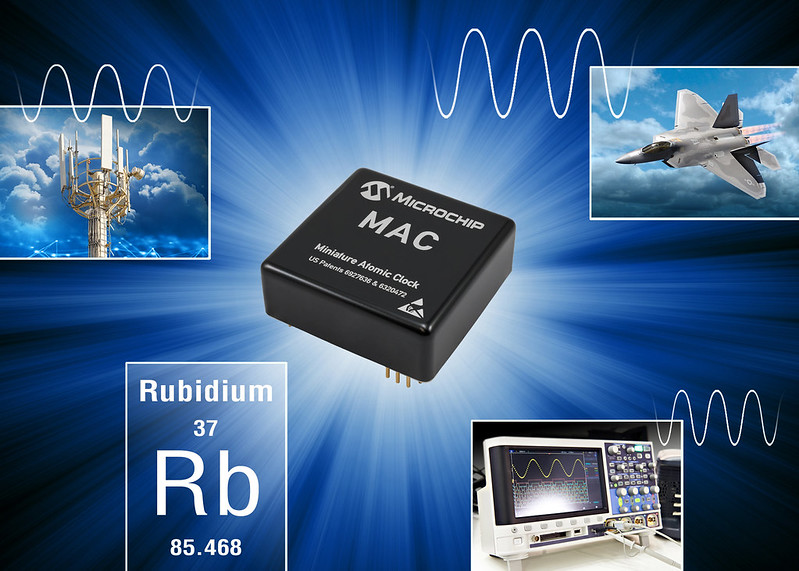
 As reliance on precise frequency and timing increases due to the Global Navigation Satellite System (GNSS) enabling 5G communication networks, data centers and other mission-critical infrastructure, smaller size and high-performance atomic clock technology has become essential to support both military and commercial applications. To meet demand for a small footprint atomic clock, Microchip Technology Inc. announced the industry’s highest performance atomic clock for its size and power. The new device also delivers a wider thermal range, critical performance improvements and other enhancements over previously available technology.
Microchip’s next-generation MAC-SA5X miniaturized rubidium atomic clock produces a stable time and frequency reference that maintains a high degree of synchronization to a reference clock, such as a GNSS-derived signal. Its combination of low monthly drift rate, short-term stability, and stability during temperature changes allow the device to maintain precise frequency and timing requirements during extended periods of holdover during GNSS outages or for applications where large rack-mount clocks are not possible. Operating over a wider temperature range of -40 to +75 Celsius, the MAC-SA5X was designed to quickly achieve atomic stability performance by taking less time to lock compared to some of the existing clock technology available in the market. In an aircraft application, for example, these attributes enable faster power up of critical communication and navigation systems in extreme climates.
The MAC-SA5X allows system developers to avoid the need for extra circuitry by integrating a one pulse per second (1PPS) input pin for fast frequency calibration, saving time and development cost. In addition, the MAC-SA5X is designed with the same footprint as previous generation miniature atomic clock technology, reducing the development time to transition to the newer, higher performance device.
Designed and manufactured in the U.S., the MAC-SA5X operates to the following additional specifications: <5.0E-11 frequency stability over operating temperature; <5.0E-11 per month aging rate; 6.3-watt power consumption; 47 cc in volume. The MAC-SA5X provides backward compatibility with its predecessor MAC-SA.3Xm family and comes in an ovenized crystal oscillator (OCXO)-sized package of 50.8 mm x 50.8 mm.
As a world leader in the research, development and manufacture of atomic clocks, Microchip has delivered more than 275,000 rubidium clocks, 120,000 chip-scale atomic clocks (CSACs), 12,500 Cesium clocks and 200 active hydrogen masers to customers worldwide.
The MAC-SA5x family of atomic clocks is supported by evaluation kit 090-44500-000, and is available now for pre-sampling. In February 2020 the MAC-SA5X will be available for deliveries. Microchip supports the MAC-SA5X with technical support services, as well as an extended warranty.

Leave a Reply