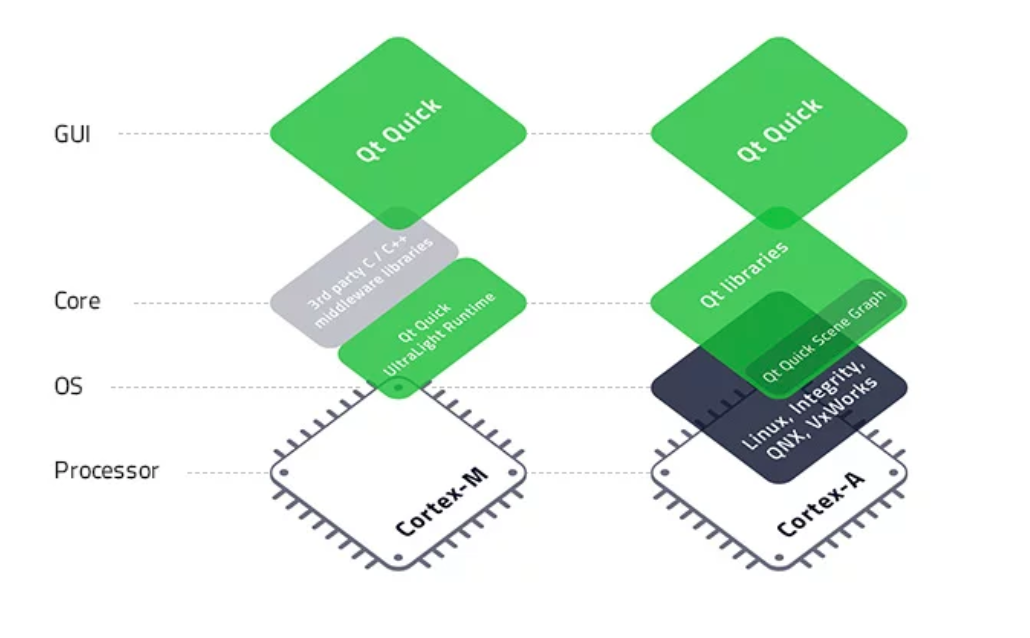
 The Qt Company today introduced Qt for MCUs to enable companies to create fluid user interfaces (UIs) on cost-effective microcontrollers (MCUs). The new offering leverages the existing tools and libraries from the widely used Qt for Device Creation, allowing companies to deliver better user experiences for displays powered by MCUs while reducing their hardware cost.
Today’s devices are smarter and offer more advanced features and capabilities than ever before, which has raised customer expectations for immersive and engaging applications and UIs. This is especially true for connected devices found in rapidly-growing sectors, including connected vehicles (in-vehicle infotainment systems and clusters), wearables (fitness trackers, smart watches), the smart home (including appliances such as refrigerators and washing machines), industrial (handheld devices, measuring devices) and healthcare (medical devices). In order to meet and exceed these expectations, application developers and device creators must be able to deliver an enhanced and intuitive user experience on par with today’s smartphones.
Qt for MCUs offers a comprehensive toolkit to enable new and existing users to deliver the user experiences their customers demand. Leveraging Qt’s popular QML technology and developer-designer tooling, Qt for MCUs allows a fast, iterative way to develop Qt applications with the frontend defined in declarative QML and business logic implemented in C/C++. The end result is a fluid graphical UI application running on microcontrollers.
Key benefits
- Reuse your existing skillsets for microcontrollers
- Reduce maintenance cost by using the same technology across multiple devices – from high-end to mass market
- Reduce hardware costs by moving to microcontrollers without compromising on graphics performance
- Upgrade to a modern, cross-platform graphical toolkit from your legacy solution

Leave a Reply