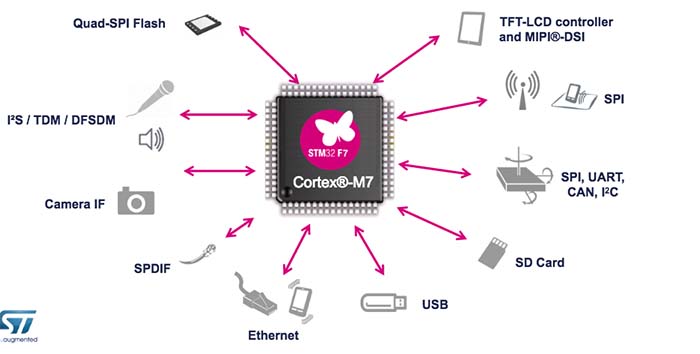
 The latest STM32F722 and STM32F723 microcontrollers in the very high-performance STM32F7 series reduce memory footprint by integrating value-added features including code-execution protection and high-speed USB physical-layer (PHY) circuitry that streamline development of connected applications. The STM32F732 and STM32F733 variants come with extra cryptographic features on-chip, such as an efficient AES256 HW engine. There are versatile package options from a 64-pin LQFP up to 176-pin LQFP or UFBGA for projects demanding high I/O count, and 256KB or 512KB of on-chip Flash memory with 256KB RAM.
Extensive pin, package, and software compatibility between the new devices and higher-end STM32F7 variants with 256KB to 2MB Flash memory and 256KB to 512KB RAM in packages up to 216-pin TFBGA simplifies design scaling for product differentiation and future-proofing. STM32F7 projects can also be readily ported throughout the large STM32 microcontroller family, which contains over 700 devices that cover all 32-bit Cortex-M cores and offer a wide range of peripheral, pin-count, and memory options.
ST is also introducing a new Discovery Kit, based on the STM32F769, with expansion connectors that include an 8-pin socket for Wi-Fi modules. The kit supports Power over Ethernet (PoE). Other features include a 512-Mbit Quad-SPI (QSPI) Flash interface and new accessories that enhance flexibility and extend application reach, including the B-LCDAD-RPI1 15-pin single row Flexible Printed Circuit DSI adapter board and B-LCDAD-HDMI1 DSI-to-HDMI adapter, which enhance flexibility to attach a wide variety of displays. The kit can also be supplied with the B-LCD40-DSI 4-inch WVGA capacitive-touchscreen display pre-fitted, or without the display for extra affordability. The B-LCD40-DSI can be ordered separately if needed to upgrade the kit at a later date.
The STM32F769 Discovery Kits (starting from $49) with wireless-ready baseboards are available immediately, as are the DSI and HDMI display-adapter boards and the 4-inch WVGA MIPI-DSI touchscreen LCD. The STM32F722/723 and crypto-enhanced STM32F732/733 microcontroller lines will enter volume production in Q1 2017. Pricing starts from $5.04 (for 10,000 units) for the STM32F722RET6 in LQFP64.

Leave a Reply