 General Micro Systems introduced a new product family of 3U and 6U OpenVPX computer boards, peripherals, and ATR-style chassis for use in U.S. Army ground, air, communications, and weapons systems. The “X9 Venom” family of 21 products will be available by early 2023, starting first with the 3U and 6U single-board computers (SBCs) based upon Intel and NVIDIA processors and GPGPUs. All products follow ANSI/VITA 65 standards, meet the Department of Defense (DoD) requirement for modular open standards approach (MOSA) electronic systems, and are IEEE 1101.2 conduction cooled. X9 Venom products are also SOSA (Sensor Open Standard Architecture) aligned and ready to meet C4ISR/Electronic Warfare Modular Open Suite of Standards (CMOSS), two standards that increasingly are requirements in U.S. Army programs and platform upgrades.
The OpenVPX standard is a common upgrade from widely deployed legacy VME-style boards and chassis. Unlike VME, however, OpenVPX modules have limited space for electronics and input/output signals, offering little differentiation between vendors or suppliers of these modules. For system designers, OpenVPX systems have fewer functions per slot and need more boards in the chassis, require complex wiring between the slots as functions “spill over,” and generally use more power, generate more heat and cost more.
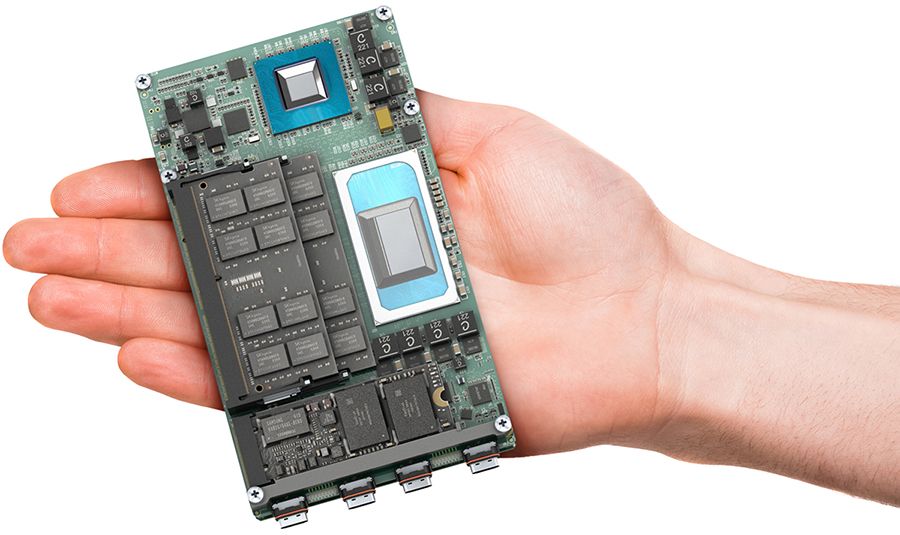
GMS’ X9 Venom product line is different, relying on GMS’ modular and super-dense X9 architecture and patented I/O, through-board and external connectors, signal conditioning, power management, and cooling to drastically increase the functionality of each X9 Venom single-board computer—better called a single-board system.
According to Sharfi, GMS accomplishes what was once deemed impossible by “folding” a larger computer board with many functions into multiple 3U-sized boards that fit into either one or two 3U slots. In addition, patented GMS connector technology and know-how routes high-speed PCI Express 4 signals (16Gbps) between the stacked boards without signal degradation. Traditional PCI Express and Ethernet data are sent to the backplane, but high-speed I/O—including 100Gbit fiber optic data and Thunderbolt 4 signals—is sent to the front panel.
GMS 3U and 6U ATR-PLUS chassis are designed to handle both backplane and front panel copper and fiber data. The 6U-sized X9 Venom boards are all single slot but essentially take the 3-board X9 architecture and place it onto a single 6U board. All boards or chassis use GMS patented “clamshell” heat sinks, wedge locks, RuggedCool or Diamond RuggedCool hot spot cooling and stiffeners, and have available LightBolt front panel connectors for copper, fiber, or fiber with up to 100W Power Delivery.
Unique to GMS’ X9 architecture, which includes the X9 Spider SFF modules and X9 Venom OpenVPX boards and chassis, is Thunderbolt 4 technology. This Intel/Apple 40Gbps interface provides USB 4/3/2, DisplayPort, PCIe, 10Gbits/s Ethernet, and up to 100W Power Delivery (when equipped). With Venom single-board systems, Thunderbolt 4 ports and 100Gb Ethernet allow data movement between cards and outside of the ATR box without loading up the limited bandwidth OpenVPX backplane. In addition, externally connected Thunderbolt 4 systems provide simple modularity, scalability, and a very easy upgrade path without having to modify an OpenVPX chassis.
Thunderbolt 4 technology and 100Gbps Ethernet provide the MOSA interoperability, scalability, and vendor independence that SOSA is trying to accomplish, without having to define the interface at the card edge all the way down to the individual pins. Any product with Thunderbolt 4 technology or Ethernet ports will interoperate and can be replaced by any other product.
Available in single-slot or dual-slot versions, in 3U or 6U sizes, and in the air- or conduction-cooled versions, X9 Venom SBCs are available with Intel’s 8-core Xeon W (Tiger Lake H), Intel’s 20-core Xeon D-2700 (formerly Ice Lake D HCC), or NVIDIA’s Jetson AGX Orin GPGPU machine image vision/AI processor. Each SBC comes fully featured, and can also be available with network-oriented functions (“NET” version), network-attached storage functions (“NAS” version), or artificial intelligence functions (“AI” version). Options are many, including up to 48TB of on-board storage, 4-6 100Gb Ethernet ports, supplemental NVIDIA RTX5000 GPGPU co-processor, and up to six Thunderbolt 4 40Gbps ports for out-of-band data movement without relying on the backplane.