The Integrate Electrical Solutions Forum came about in 2000 as a conference for the automotive engineering community. The original events were organized by Mentor Graphics and SAE. Since Mentor’s acquisition by Siemens, the event has been run by the Siemens Digital Industry Software group. The current version of IESF includes a mix of technical and business presentations, panels, and workshops. The 2022 event was the first to be held in-person since the pandemic, and over 800 automotive developers and engineers attended the confab in Plymouth, Mich. Here are a few of the more notable presentations we saw during our time there.
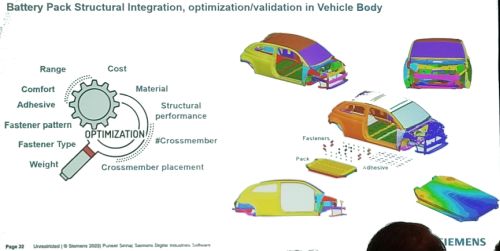
Examining the structure of a battery pack
Digital twins have been the go-to approach for designing automotive hardware and systems. Now the concept is coming to automotive batteries. Puneet Sinha explained the process as it stands today. As you might expect, the structural qualities of battery packs can be approached this way. But Sinha says digital twins can be used to figure out what happens when you scale up new battery chemistries and can help ferret out what the battery needs to look like to do what’s required. This is a change from recent history, he says, which could be described as an experiment-only approach. Simulation can not only get the battery chemistry right but also help define safety measures for battery packs. “Packs are more than just an assembly of cells,” he says. “Simulation can get you to what the overall battery structure needs to look like.”
Making Linux devices talk to Autosar
One of the demos running in the refreshment room had an NXP iMX8 QuadMax SoC board connected to a peripheral board representing an Autosar seat heater in a car. The NXP CPU contains two 1.6-GHz Cortex-A72 CPUs and four 1.2-GHz Cortex-A53 CPUs. The point of the demo was to show how you could pair devices operating under Linux with those on Autosar networks using a single device, taking advantage of the multiple cores as found on the NXP iMX8. Siemens’ Jeff Hancock took us through the demo.
Is your car safe?
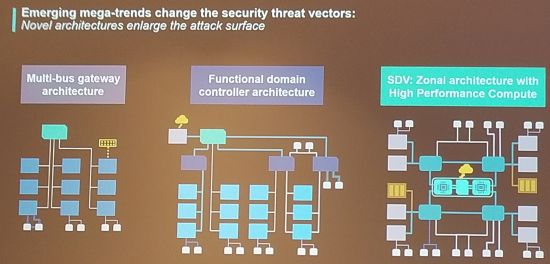
In the rush for safety, cybersecurity is often neglected, says Hans-Juergen Mantsch of Siemens EDA in Germany. Exposing the vehicle internal control logic to public IP networks exposes them to the risk of hazards such as unwanted remote control or injection of malicious code. His presentation described EE systems development flow focused on how to deliver security requirements for in-bound and out-bound vehicle communication. The basic idea is to partition the architecture of the vehicle into secure and insecure areas, then handle anything in the insecure areas with a zero-trust security model. Zero trust basically means continuous verification. A zero trust network assumes there are attackers both within and outside the network, so no users or machines are automatically trusted. It involves verification of user identity and privileges as well as device identity and security.
Developing a battery management system
The folks at Neutron Controls up in Ottawa, Canada came down and gave us a demonstration of their battery management system development kit. It includes an assembly of batteries which can be monitored and balanced. The system has all the necessary components to create a complete BMS to control contactors, battery chargers, and battery loads.
IC security in vehicles
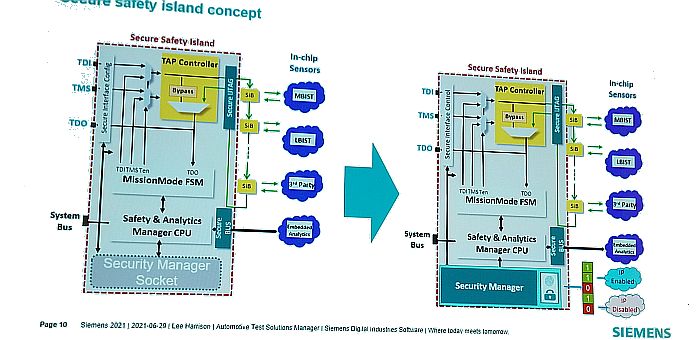
As we add more and more monitoring capabilities within automotive IC it becomes more useful to start building data models for reliability and their use. But the addition of monitoring capabilities brings the threat of introducing security vulnerabilities. So the security of the test safety and monitoring infrastructure becomes a big consideration, says Siemens DIWS automotive test solutions manager Lee Harrison. Harrison says a hardware root of trust is part of the answer. It provides an ID for each device in the system via a digital fingerprint and enables a secure boot process. It is inherently trusted, and therefore must be secure by design. But it’s impractical to use a root-of-trust for every IC in the system, so the approach used is that of a secure island architecture.