The new DA14531 is being billed as the world’s smallest and most power-efficient Bluetooth 5.1 SoC and module to simplify Bluetooth product development and enable wider adoption.
The chip, also known as SmartBond TINY, is currently in production. It will further extend 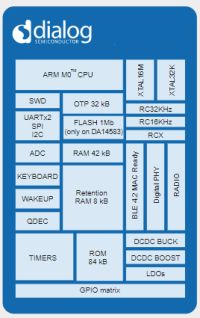 Dialog’s position as a leader in the Bluetooth device market with the broadest SoC portfolio, as the company converges on yearly shipments of up to 100 million units.
SmartBond TINY is specifically designed to lower the costs of adding BLE functionality to an application to as little as $0.50 in high volumes, fueling the next wave of the IoT, estimated to span over 1 billion devices.
As the list of devices requiring wireless connectivity continues to grow, the cost of enabling a complete IoT system is under pressure. SmartBond TINY addresses the growing breadth and costs of IoT devices by enabling a complete system cost reduction through a smaller footprint and size, while maintaining performance quality at a level unmatched by its competitors. The DA14531 makes it possible to extend wireless connectivity to applications where it would have previously been prohibitive in terms of size, power or cost, especially those within the growing connected medical field. SmartBond TINY will help facilitate connectivity for inhalers, medicine dispensers, weight scales, thermometers, glucose meters and more.
At half the size of its predecessors, SmartBond TINY is available in packages as small as 2.0×1.7 mm. Moreover, the SoC’s high level of integration only requires six external passives, a single clock source and a power supply to make a complete Bluetooth low energy system. For developers, this means SmartBond TINY can easily fit into any design, such as electronic styluses, shelf labels, beacons or active RFID tags for asset tracking. It will also be critical for applications that require provisioning such as cameras, printers and wireless routers. Consumers will also reap the benefits of SmartBond TINY’s reduced system size and power, in remote controls as a replacement for infrared (IR) or for other applications such as toys, keyboards or smart credit and banking cards.
SmartBond TINY is based on a powerful 32-bit Arm Cortex M0+ with integrated memories and a complete set of analog and digital peripherals, delivering a record score of 18300 on the latest IoTMark-BLE, the EEMBC benchmark for IoT connectivity. Its architecture and resources allow it to be used as a standalone wireless microcontroller or as an RF data pipe extension for designs with existing microcontrollers.
The SmartBond TINY module, leveraging the capabilities of the main DA14531 chip, makes it easy for customers to leverage the new SoC as a part of their product development, instead of having to certify their platforms themselves, thereby saving time, development efforts and costs.
The module is also designed to balance running a high number of applications while keeping cost additions to the overall system as low as possible. Breaking through the $1 target for a BLE module lowers the threshold for adding SmartBond TINY to a system and driving a multitude of applications, helping fuel a new generation of IoT-enabled devices.
SmartBond TINY and the module use just half of the energy of their predecessors, the DA14580 and DA14580-based module, as well as all other offerings currently on the market. TINY’s record-low power consumption ensures a long operating and shelf life, even with the smallest of batteries. The DA14531’s integrated dc-dc converter enables a wide operating voltage (1.1 to 3.3 V) and can derive power directly from environmentally-friendly, disposable silver oxide, zinc-air or printable batteries required for high-volume applications, such as connected injectors, glucose monitors and smart patches.
“The addition of SmartBond TINY and the module builds upon Dialog’s leading presence in the Bluetooth market. With the ability to turn any device, even disposable ones, into a connected application, the TINY SoC and module are opening new markets and driving the adoption of BLE beyond what was previously thought possible in today’s landscape,” said Sean McGrath, SVP, Connectivity and Audio Business Group of Dialog Semiconductor. “TINY and its module’s small size and power footprint, combined with Bluetooth 5.1 compliance, pave the way for the next one billion IoT devices.”
Dialog Semiconductor plc, https://www.dialog-semiconductor.com/products/DA14531



Leave a Reply