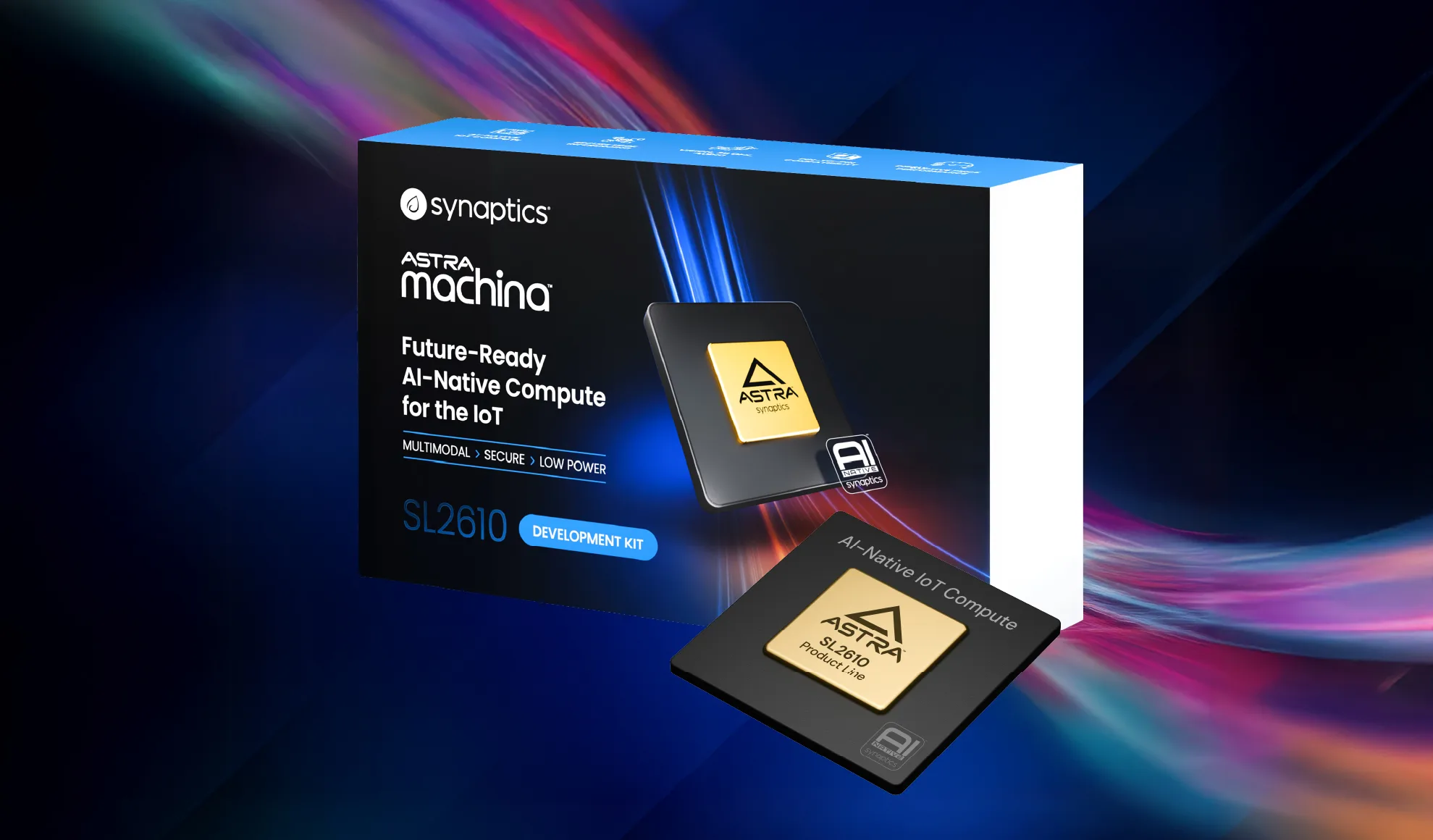
 Synaptics Incorporated has announced the Astra SL2600 Series of multimodal Edge AI processors for IoT applications. The initial launch consists of the SL2610 product line, comprising five processor families targeted at edge computing applications.
The processors are designed for smart appliances, home and factory automation equipment, charging infrastructure, healthcare devices, retail point-of-sale terminals and scanners, autonomous robotic systems, UAVs, and casual gaming devices.
The SL2610 processors utilize the Synaptics Torq Edge AI platform, which includes Google’s RISC-V-based Coral Open NPU with dynamic operator support, an open-source IREE/MLIR compiler and runtime, Arm Cortex-A55 and Cortex-M52 with Helium technology CPU cores, Arm Mali GPU, and security features including immutable root of trust, threat detection capabilities, and an application crypto coprocessor.
The SL2610 line includes five pin-to-pin compatible processor families: SL2611, SL2613, SL2615, SL2617, and SL2619. These variants span applications from battery-powered and passively cooled devices to high-performance industrial vision systems.
The processors integrate with Synaptics Veros Connectivity platform, supporting Wi-Fi 6/6E/7, Bluetooth/Bluetooth Low Energy, Thread, and Ultra-Wideband (UWB).
The SL2610 incorporates Google Research’s Coral Open NPU ML accelerator. Industry partners collaborating on solutions include Sonos, Cisco, Garmin, Deutsche Telekom, Verisure, Arm, and several system-on-module providers (Grinn, Toradex, TechNexion). Moonshine AI has implemented their speech recognition software on the platform.
The platform’s open-source compiler toolchain and use of standard Arm cores may facilitate software development and porting. The pin-to-pin compatibility across the five families enables design scalability without board redesign. Native transformer model support is included in the SL2610.
Samples are currently available to customers. Volume production is scheduled for Q2 2026.




Leave a Reply