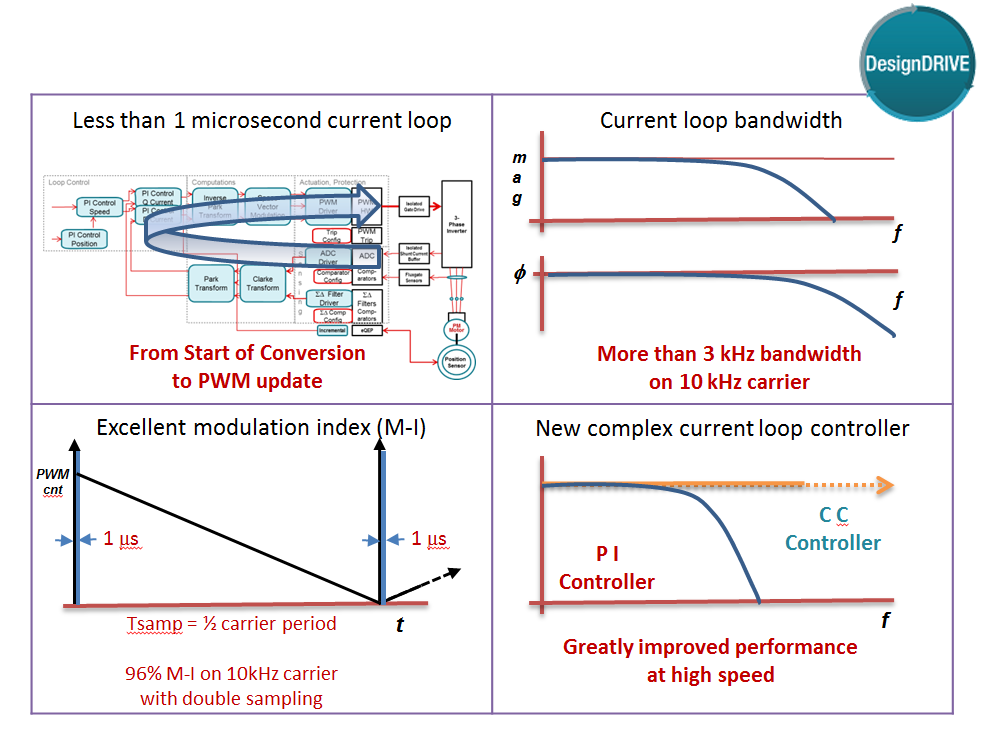
 Texas Instruments introduced DesignDRIVE Fast Current Loop software that makes C2000 microcontrollers (MCUs) the first devices to push current-loop performance to less than 1 microsecond. Together, TI’s C2000 MCU portfolio and DesignDRIVE software delivers system-on-chip (SOC) functionality which simplifies drive control system development. New DesignDRIVE Fast Current Loop software outperforms traditional microcontroller (MCU)-based current-loop solutions and can simplify designs by eliminating the field-programmable gate array (FPGA) typically used for external current-loop control. Fast Current Loop software is a free update available for C2000 controlSUITE software.
TI’s DesignDRIVE technology is a unified hardware and software platform that makes it easier for engineers to develop and evaluate solutions for a variety of industrial drive and servo topologies. As a key part of DesignDRIVE solutions, the new Fast Current Loop software enables developers to achieve higher control performance while saving valuable board space and simplifying thermal considerations.
Features and benefits of TI’s DesignDRIVE Fast Current Loop software
- Innovative subcycle pulse-width modulation (PWM) update techniques significantly improve control-loop bandwidths to potentially triple the motor torque response.
- A novel cycle-scavenging C2000 MCU needs only 460 nanoseconds for field-oriented control processing.
- A new complex controller replaces traditional proportional integration control and facilitates greater stability at higher speeds.
- Industrial drive systems designed with Fast Current Loop software on a C2000 MCU, like the TMS320F28379, delivers SOC functionality to reduce board space, complexity and overall cost.
Developers can get started immediately by downloading TI’s free new Fast Current Loop software on the DesignDRIVE solutions page. In addition, the C2000 DesignDRIVE development kit for industrial motor control (TMDXIDDK379D)
The new DesignDRIVE Fast Current Loop is available today for the C2000 Delfino™ TMS320F2837x family of MCUs for advanced control applications start at US$11.32 in 1,000-unit quantities available in the TI store and at authorized distributors. Additionally, the C2000 DesignDRIVE development kit (TMDXIDDK379D) is available for immediate purchase for $999. TI plans to offer Fast Current Loop support for the TMS320F2807x and TMS320F28004x C2000 Piccolo™ MCUs in the future.

Leave a Reply