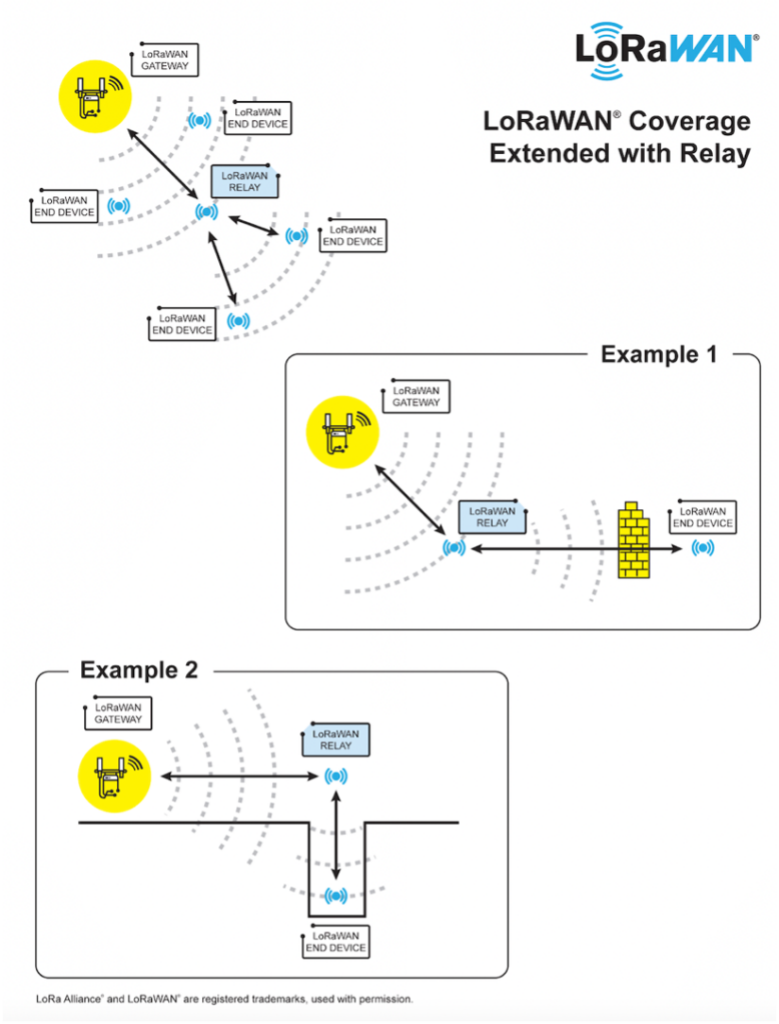
 The LoRa Alliance announced that it has expanded the LoRaWAN link-layer standard with the addition of a relay specification. Relay allows for battery-operated, easy-to-deploy network coverage extensions at a fraction of the cost of adding additional gateways. This allows LoRaWAN to achieve excellent coverage in use cases requiring deep indoor or underground coverage, or relay data on satellite-connected LoRaWAN devices within proximity. The LoRa Alliance is hosting a webinar about the new relay feature tomorrow, October 4 at 7 am US PDT.
One of the first markets to adopt relay is metering in the utility sector. Utilities represent a massive opportunity for IoT, with VDC Research estimating that worldwide LPWAN communication services revenue will reach $2.47 billion by 2025. Adding relay to the LoRaWAN standard to achieve coverage for even the most difficult cases (e.g., meters inside metal closets) significantly strengthens LoRaWAN’s market position in metering and utilities, and more broadly across key verticals including smart cities and buildings, and industrial IoT. Using a relay is ideal for any application monitoring static assets in challenging environments.
The LoRaWAN standard is proven for long-range communications, however, there can be physical limits to where LPWAN communications can reach, such as around turns, underground, where a signal needs to be reflected/relayed into a specific location, etc. LoRaWAN relays allow signals to go where they physically couldn’t go before. The LoRaWAN TS011-1.0.0 LoRaWAN Relay Specification document describes the relaying mechanism used to transport LoRaWAN frames bi-directionally between an end-device and gateway/network server via a battery-operated node. By enabling relay, the device can transfer LoRaWAN frames between an end device and network when there is insufficient coverage from the gateway.
This specification enables Network coverage extension through the battery-operated relay and maintains compatibility with the LoRaWAN Link-Layer standard in terms of protocol and security. The new relay nodes are battery-powered and can be installed anywhere and do not require electricity or internet connectivity. This makes them a very easy-to-deploy, low cost and a low-power way to extend network coverage, without needing to add additional gateways. Relay endpoints allow LoRaWAN to provide coverage of all devices with only a nominal cost of installation.