The Khronos Group, an open consortium of industry-leading companies creating advanced acceleration interoperability standards, has developed a royalty-free Vulkan safety-critical (SC) 1.0 API Specification to enable safety-critical industries to deploy state-of-the-art GPU graphics and compute acceleration while meeting the highest levels of functional safety requirements. The Vulkan SC Conformance Test Suite is also freely available in open source, and multiple vendors have officially-conformant Vulkan SC 1.0 implementations. Industry feedback on the specification is welcome at the Vulkan SC specification GitHub repository.
Demand for advanced GPU-accelerated graphics and compute is growing in a wide range of industries where safety is paramount such as automotive, autonomy, avionics, medical, industrial, 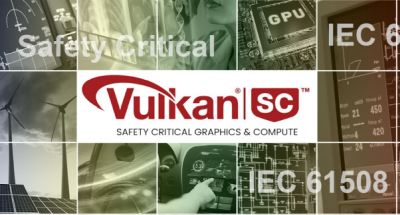 and energy. Where a compute or display system failure would pose a significant safety risk it is critical that systems meet safety-critical standards such as RTCA DO-178C Level A/EASA ED-12C Level A (avionics); FACE (Future Airborne Capability Environment) (avionics); IEC61508 (industrial), IEC62304 (Medical), and ISO 26262 ASIL D (automotive). To streamline system-level safety-critical certifications, system components such as acceleration APIs should be streamlined as far as possible to reduce documentation and testing surface area, have deterministic behavior and predictable execution times to simplify design and testing and implement robust and unambiguous fault handling. The new Vulkan SC 1.0 specification leverages the proven Vulkan 1.2 API to meet these requirements while delivering state-of-the-art graphics and compute acceleration. Vulkan SC also decouples software and hardware development for easier integration of new hardware components and software reusability across platforms and system generations.
“Vulkan 1.2’s modern design for explicit control over GPU resources was the ideal foundation for building this next-generation safety-critical GPU API that provides significantly increased performance and control over graphics and compute dataflows than was possible with OpenGL SC 2.0,” said Steve Viggers, of CoreAVI and Vulkan SC working group chair. “Vulkan SC 1.0 enables detailed design and control of device scheduling, synchronization, and resource management, making it the ideal API for developing the next generation of safety-critical graphics and compute applications targeting modern GPUs.”
Vulkan SC removes functionality from Vulkan that is not needed for safety-critical markets, increases the robustness of the specification by eliminating ignored parameters and undefined behaviors, and enables enhanced detection, reporting, and correction of run-time faults. Vulkan SC 1.0 is also aligned with the MISRA C software development guidelines for embedded code safety, security, portability, and reliability. Vulkan SC increases determinism and reduces application size by shifting preparation of the run-time application environment either offline, or into application setup, as much as possible. This includes offline compilation of graphics pipelines that define how the GPU processes data, together with static memory allocation, that together enable detailed GPU control that can be rigorously specified and tested.
All Vulkan SC pipelines are compiled offline and can be statically analyzed to understand the dataflow and the amount of memory used by the pipeline processing. The memory needed for pipeline execution can then be reserved at device creation time as fixed size pools to minimize memory usage and avoid the need for runtime memory allocation. Similarly, Vulkan SC enables the application to statically pre-allocate the upper bound of application memory requirements, avoiding the need for runtime dynamic memory management.
The Vulkan SC Conformance Test Suite (CTS), built upon the robust Vulkan CTS, is an important tool for API implementers to exercise the completeness of their implementations. The rigorous CTS also assists system integrators to confirm specification compatibility and generate certification evidence packages, as well as maximizing software portability and reuse across systems. Conformant Implementations are running today on CoreAVI, and NVIDIA DRIVE and Jetson Platforms.
The Khronos Group, 14525 SW Millikan Way, Ste 4504,3 Beaverton, OR 97005-2343, (415) 869-862, www.khronos.org




Leave a Reply