
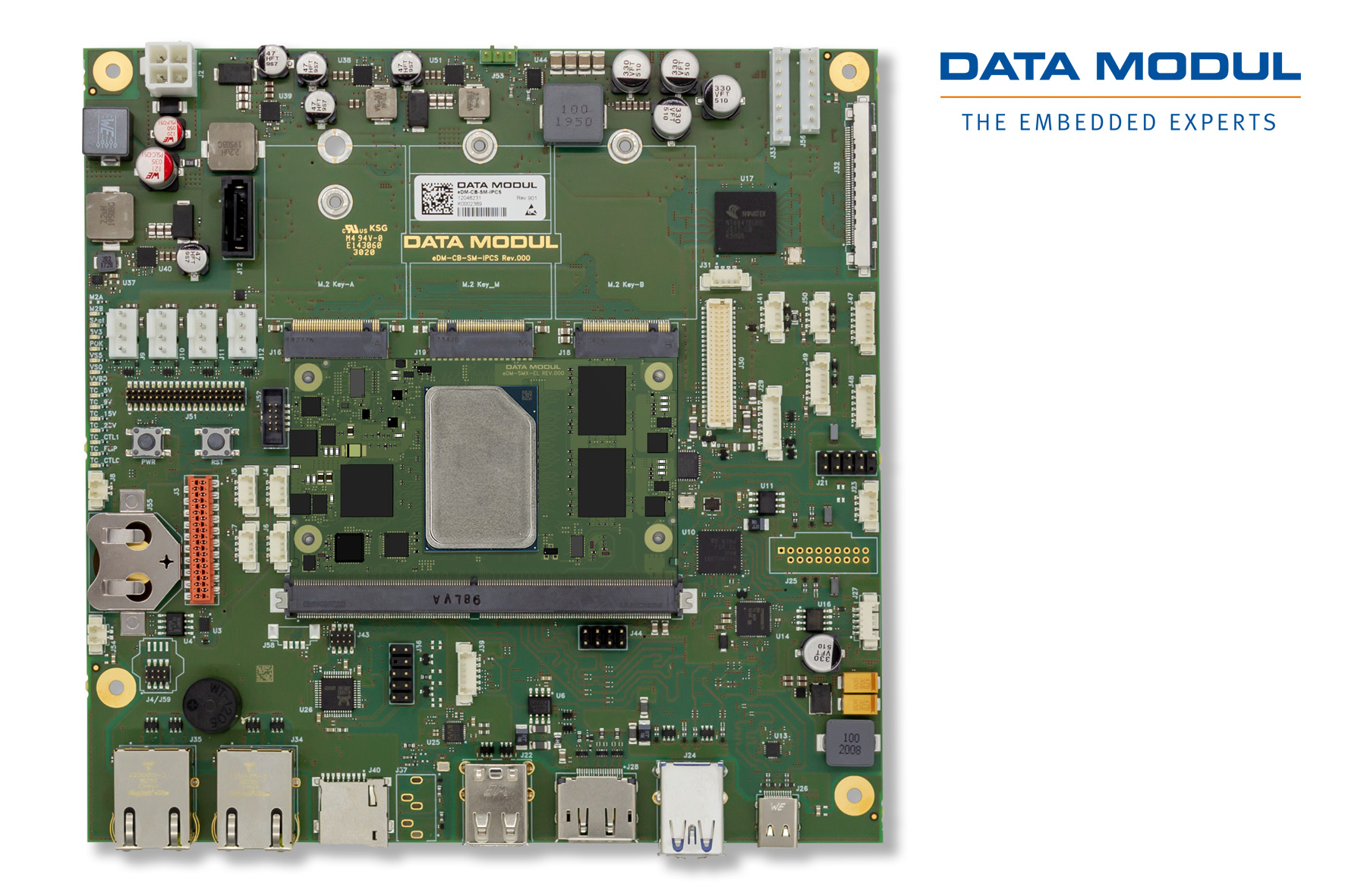
 DATA MODUL is expanding its carrier board portfolio in the embedded sector, bringing a universally applicable carrier board onto the market in the form of the eDM-CB-SM-IPCS. The new board is compatible with Intel’s latest Atom x6000E, Celeron, and Pentium (“Elkhart Lake”) processor platforms, as well as with future x86 generations and ARM platforms. Furthermore, the embedded motherboard offers a high degree of scalability and flexibility suitable for a wide range of applications owing to its SMARC standards.
The eDM-CB-SM-IPCS appears in the thin mini-ITX format and as a modular platform, offers an ideal starting point for customer-specific designs. It is easy to add or remove features, which can reduce the time to market and decrease the cost of the customer application.
A noteworthy feature is a V-by-One interface to operate high-resolution V-by-One displays with up to 4k resolution. The board can supply all displays with up to 60 watts via this interface and the backlight with up to 144 watts using a separate connector. Hence, large format and high-resolution HMI systems can be driven directly by this motherboard. In addition, displays with standard interfaces like DisplayPort or LVDS can also be connected. As another highlight, the carrier board has a USB-C port, which supplies external systems with up to 100 watts and supports DisplayPort including USB 3.1.
Further noticeable attributes include two GbE, three M.2 slots of types A, B, and M, four USB 3.0, and SATA 3 for external hard drives or SSDs. With the help of DATA MODUL’s Feature-Connector, the functionality of the eDM-CB-SM-IPCS can be further expanded.
In addition to the new carrier board, DATA MODUL has announced the launch of the eDM-SMX-EL, an in-house 2.1 SMARC module with the newest low-power Intel Atom x6000E processors. Outstanding features include its memory of up to 16 GB LPDDR4X, two USB 3.1 interfaces, and an onboard UFS 2.1 flash memory, which offers faster data transfer and greater storage capacity in comparison to the eMMC 5.1. Thanks to its small size and high performance, the new module is ideally suited for the IoT and multimedia platforms, as well as for real-time applications that require a low profile. Moreover, due to its extremely long operational lifetime of 10 years, even with 24/7 continuous operation, a very low maintenance cost is incurred.
The first samples of the eDM-CB-SM-IPCS will be available at the end of November. Further information is available here.



Leave a Reply