Physical AI (PAI) in autonomous and electric vehicles (EVs) involves systems that perceive the environment, make intelligent decisions, and execute appropriate actions in real-time, bridging the gap between digital intelligence and physical motion.
PAI is autonomous, and electric vehicles can be used for several functions. Initially, it’s helping improve battery management and energy efficiency. In the longer term, it’s expected to enable increasingly capable autonomous driving systems. In all cases, it can be broken down into five components (Figure 1):
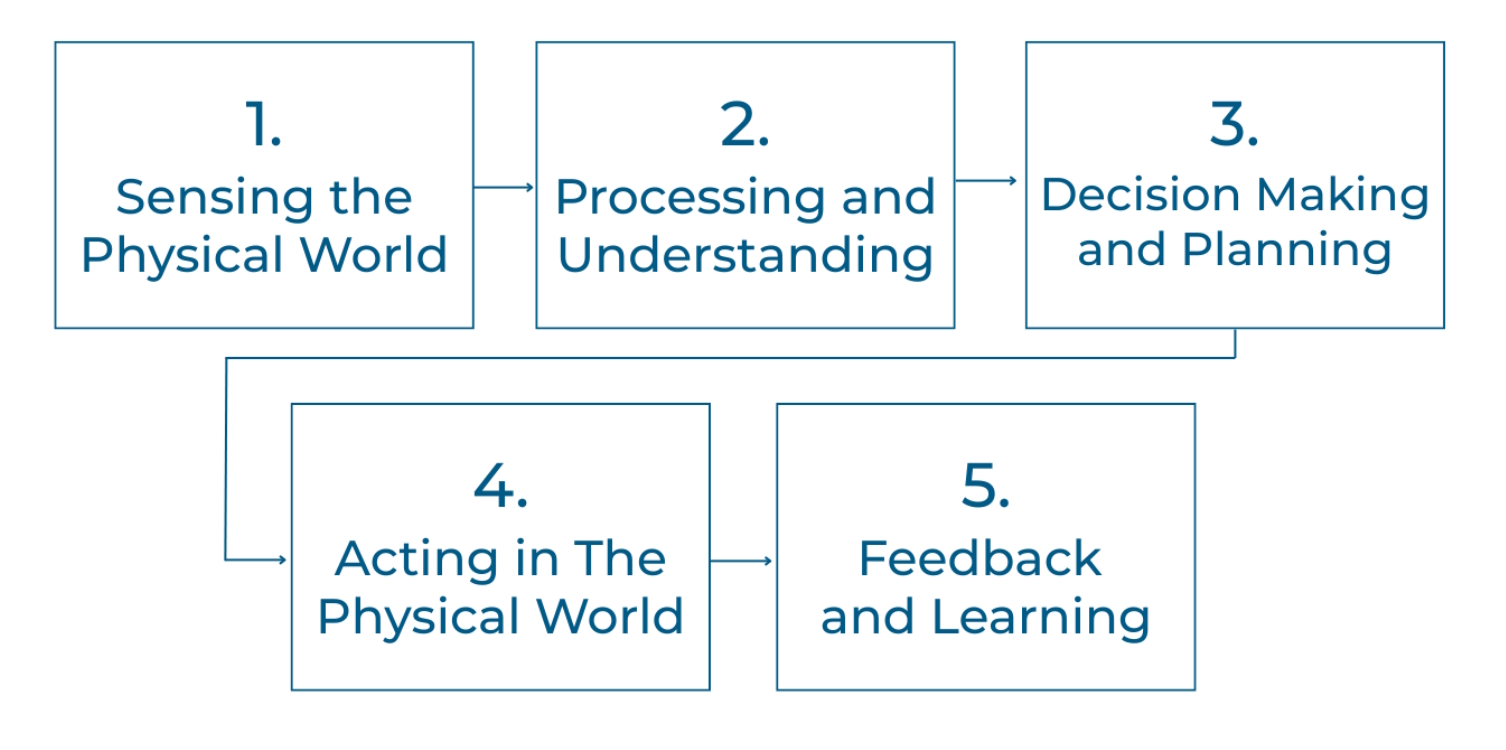
- Sensors to provide information about the environment.
- Processing and understanding the sensor data.
- Using that understanding to make decisions.
- Taking physical action to implement those decisions.
- Feedback on results to enable continuous learning and improved results.
Sensor fusion that integrates data from several sensors is critical. In the case of battery management, it can combine information about temperature, vibration, and charge/discharge rates, and for autonomous driving, it uses sensors like LIDAR, cameras, radar, and inertial motion to optimize performance.
That makes edge computing important since there’s no time to send the information to the cloud and wait even a second for a response. Machine learning (ML) algorithms like TinyML can be used on the vehicle to identify complex patterns and optimize future decision-making.
Battery management and PAI
Physics-informed neural networks (PINNs) add the integration of fundamental physics laws into basic AI, creating smarter, more accurate models that better understand complex battery behavior (aging, thermal dynamics, and so on), adding scientific rigor for improved battery management, more accurate predictions of driving range, and so on. But PINNs don’t act on those improved predictions, PAI does.
PAI can implement adaptive control, enabling personalized energy management, optimization of charge rates, and extended lifespan through dynamic control of temperature, voltage, and current, preventing degradation and improving driving range and battery safety.
In addition, PAI can be used to implement grid-interactive behaviors like coordinating charging rates with grid demand, energy costs, and anticipated driving schedules. That can reduce grid strain and charge costs, and further enhance long-term battery health.
PAI for autonomous operation
DAI can be useful for navigation and path optimization to maximize battery life or minimize travel time. PAI creates autonomous vehicles that directly interact with the physical world, recognizing physical objects, understanding spatial relationships and physics (gravity, friction, inertia, and so on), and implementing actions.
PAI can control speed, acceleration, deceleration (braking), and steering. It can adapt to real-time conditions like changes in weather, different driving surfaces, or unexpected obstacles like stalled vehicles, traffic jams, roadwork, and so on.
Five levels of PAI in autonomous vehicles
PAI is not specifically recognized in the SAE J3016 standard for “Artificial Intelligence Use Cases for Ground Vehicle Applications.” However, in line with the SAE standard, the use of PAI can be envisioned as follows (Figure 2):
- Level 0 – no automation – there is no PAI in use for driver assistance, and the driver must have full control of the vehicle at all times. PAI may be used for occupant comfort and other functions not associated with autonomous operation.
- Level 1 – driver assistance – the vehicle PAI can provide limited assistance with steering or braking, but the driver is still responsible for most aspects of driving.
- Level 2 – partial automation – the vehicle PAI provides increased assistance of steering, acceleration, and braking in defined situations, but the driver must still be ready to take control at any time.
- Level 3 – conditional automation – the vehicle PAI can take full control in limited situations and does not generally require human control, but the driver must be prepared to take over as needed or when alerted by the system.
- Level 4 – high automation – the vehicle PAI can take full control in most situations, including traffic jams, but the driver may still have the option to take control if desired or if circumstances require.
- Level 5 – full automation – the PAI controls the vehicle in all situations. The vehicle will not include a steering wheel or braking and acceleration controls.

Summary
PAI is finding its initial use in EV battery management, where it can improve driving range and enhance battery lifetimes. It’s beginning to find application in autonomous driving systems and will be the key to achieving fully autonomous operation in the future.
References
AI-Enhanced Battery Management Systems for EVs, Octopart
Aspects of artificial intelligence in future electric vehicle technology for sustainable environmental impact, Environmental Challenges
From Passive to Adaptive: The Rise of AI-driven Battery Management Systems, Electra
How AI is accelerating the future of electric vehicles, appinventiv
How AI is making electric vehicles safer and more efficient, IBM
How AI is Revolutionizing Battery Life Prediction: Real-world Case Studies, Xbattery
How Physical AI Is Redefining the Automotive Industry, Cadence
Preventing Machine Breakdowns: How Physical AI Predicts Equipment Problems, AWS
The Role of Artificial Intelligence in Autonomous Electric Cars, Cyber Switching
The Role of Artificial Intelligence in Shaping the Future of Electric Vehicles, Advances in Consumer Research
The World of AI and Driverless Cars, Inspirit AI
Transforming the physical world with AI: the next frontier in intelligent automation, AWS
What is Physical AI?, Iris
Related EE World content
How can AI/ML improve sensor fusion performance?
What are the mathematics that enable sensor fusion?
How can agentic AI be used in autonomous systems like EVs?
What are the challenges in designing V2X and radar antenna connectors?
What are common sensor fusion applications in EVs?





Leave a Reply