Optical wireless communications in the form of “Li-Fi” is a technical alternative to RF-based Wi-Fi with distinct strengths and weaknesses.
Part 2 of this article looked at Li-Fi attributes and building blocks. This part looks at Li-Fi system-level issues and offers a perspective on Li-Fi’s present market acceptance.
Q: Can I use Li-Fi today?
A: Yes and no. At present, there are no standard laptops or smartphones with the built-in needed Li-Fi functionality (there are some hobbyist custom hacks, of course). Still, you can get a USB-connected accessory (“dongle”) from several vendors who provide Li-Fi connectivity. One such unit is the LumiStick II LiFi USB Adapter from Vincomm with a 120⁰ field of view (Figure 1). It uses visible light at 420 to 680 nanometers (nm) for the downlink and supports up to 108 Mbps download and infrared 800 to 875 nm for the uplink at up to 52 Mpbs.
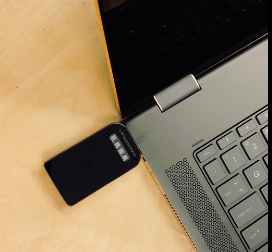
Q: It all seems easy enough, so what’s the impediment to getting on a Li-Fi link?
A: You still need to be in a Li-Fi-enabled room or setting. There are some of these at universities as testbeds and even in some commercial settings, but these are few. To encourage installations, companies such as Vincomm, Signify (formerly Philips Lighting), and others offer LED-based ceiling light fixtures (luminaires) which combine lighting and Li-Fi connectivity (Figures 2 and 3).
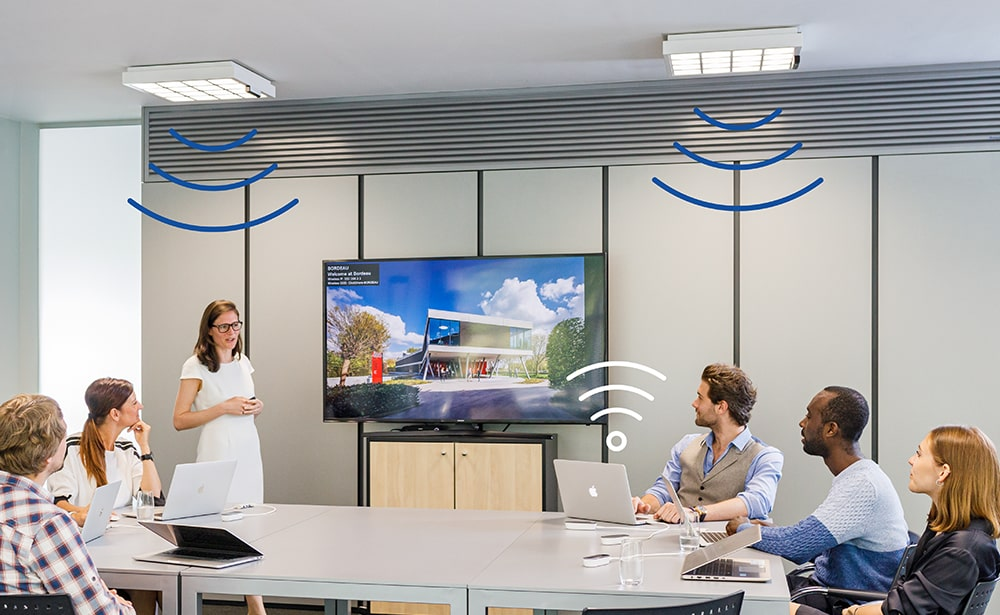
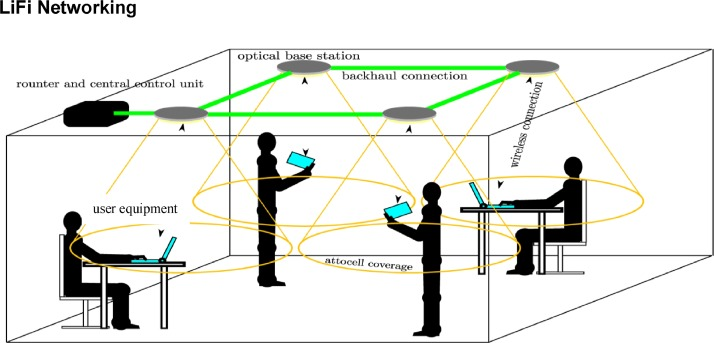
Q: Are there situations where Li-Fi would offer distinct, immediate advantages?
Q: Some hospitals are testing it for use in corridors and even operating rooms with serious issues with Wi-Fi congestion and EMI-induced interference and signal corruption. These result in poor SNR, low throughput, and spotty or lost connectivity and can even affect co-located electronic systems. Airlines are considering it in aircraft cabins for the same reason, with a ceiling-mounted node every few rows.
Q: Combining overhead area lighting with Li-Fi seems like a good idea, but is it practical?
A: Yes, it is (with caveats), and Li-Fi proponents encourage LED-lighting vendors to incorporate Li-Fi transceivers into their various bulbs and fixtures. You can buy some today, but keep in mind that it is no longer just a lighting source. It also needs to be connected to a backhaul to get to the Internet.
Q: What are some of the issues?
A: Whenever you try to “piggyback” (co-locate) data onto a power line or power onto a data connection, there will be issues. Driving power LEDs for illumination, even with PWM dimming at a few hundred hertz, is now straightforward but requires solid current drive; sending data at Mbps over CAT-class in-building cabling is also straightforward but requires fast switching. These two objectives can be in conflict.
Q: Can you elaborate?
A: Consider Power over Ethernet (PoE). Doing either one alone is clear cut but putting them together brings a whole set of safety, performance, and protection issues necessitating special circuitry, isolation transformers, and more to keep the data and power apart when they have to be and ensure that glitches, surges, and transients on either one do not or cause failures on the other. Similarly, using the AC power line as a data conduit has been done successfully but comes with many challenges and limitations because the line voltages involved inevitable and large voltage/current transients. There are also thermal and co-packaging issues to resolve or overcome.
Q: What’s the status and reality of Li-Fi?
A: Despite the promotion, demonstrations, distinct technical advantages (and weaknesses), available products, and adequately mature technology, Li-Fi has not caught on. That’s despite some very optimistic market projections made over the recent, which had numbers into the billions of dollars for the Li-Fi market. Not surprisingly, Li-Fi proponents tend to highlight its benefits and downplay its limitations, of course.
Q: Why hasn’t it caught on?
A: It’s very easy to speculate but impossible to prove. Among the possible reasons for the very slow uptake of Li-Fi are these:
- Wi-Fi is adequately solving the “wireless” connectivity problem for most people, and they don’t see a need for it.
- The real or touted benefits are really “don’t care” points for many users.
- The limited range (10 meters), mostly line-of-sight positioning and difficulties with “wandering” when using it are limitations (except for those who want or need the additional security it offers).
- Adding Li-Fi transceivers and nodes to lighting fixtures is not necessarily a simple upgrade in terms of cost and complexity compared to setting up a Wi-Fi access point.
- Wi-Fi got there first, and a second solution is often a “tough sell” unless it is dramatically better and cheaper, or the existing solution is falling short in too many ways.
- Incorporating it into laptops or smartphones rather than as an optional USB dongle (for laptops) adds cost and complexity and has serious product-packaging implications. The LED and photoreceiver must be on the outside of the case, near the top.
- It’s a classic “chicken and egg” dilemma: vendors won’t add Li-Fi to laptops and smart phones or upgrade their buildings unless there’s a demand for it; there’s little demand for it because the device and building infrastructure is not there in place.
Q: What will become of Li-Fi?
A: No one knows. It could a) become a big winner in niche markets and applications, or b) could “limp along” but never really take off, or c) it could atrophy and disappear. Advocates for Li-Fi see it as a natural extension and complement for 5G wireless due to its speed, so perhaps the emergence of 5G will give it a hook to attach to and then accelerate its place in the market. Right now, Li-Fi is a mix of hope, hype, promise, and potential. So….you’ll have to check back in three to five years.
EE World Related Content
Report: Global Light Fidelity (Li-Fi) Technology Market to Reach $35.82 Billion By 2028
Textured LED Gives Green Light To Li-Fi
Light-Based Transmission Test Comes to the Workplace
This Wireless Technology Is 100 Times Faster Than Wi-Fi
Company turns LED lights into a Wi-Fi network
External References
Wi-Fi and IrDA
- CableFree, “WiFi Standards and Development History”
- Brittanica, “Wi-Fi networking technology”
- McCannTech, “Wi-Fi 101 — Wi-Fi Origins and History”
- ThoughtCo, “Who Created Wi-Fi, the Wireless Internet Connection?”
- Wikipedia, “Infrared Data Association”
Technical and Vendor Material
- Wikipedia, “Li-Fi”
- Signify, “What is LiFi?”
- Pure LiFi, “LiFi Technology”
- co, “LiFi: Wireless data from every light bulb”
- Science Direct, “LiFi is a paradigm-shifting 5G technology”
- Avnet, “Li-Fi: IoT at the Speed of Light”
- Iberdrola, “LiFi, the internet at the speed of light”
- Versa Technology, “Li-Fi: Internet at the Speed of Light”
- Li Fi Tech News, “Top 15 Li-Fi Applications”
- IEEE Internet Initiative, “Li-Fi: An Overview, Part 1 – Purpose and Function”
- Mordor Intelligence, “Li-Fi (Light Fidelity) Market – Growth, Trends, COVID-19 Impact, and Forecasts (2021 – 2026)”
- VLNcomm, “Limitless Connectivity”\IEEE, “Optical data transmission using portable USB Li-Fi module (dongle)”
- International Journal of Engineering and Advanced Technology (IJEAT), “Data Transmission using Visible Light Communication”
- International Research Journal of Engineering and Technology (IRJET), “Data Transmission Through Li-Fi”
- International Journal of Advance Research in Computer Science and Management Studies, “Li-Fi Technology: Data Transmission through Visible Light“
- Arvix, “Conceptual Design of LiFi Audio Transmission Using Pre-Programmed Modules”
- Oledcomm, “What is LiFi?”
- Circuit Digest, “Li-Fi based Text Communication between Two Arduino”
Li-Fi News and Updates
- IEEE Spectrum, “Li-Fi Scrubs Into the Operating Room”
- IEEE Spectrum, “Infrared Light Promises Ultrafast Wireless Communications”
- LEDs Magazine, “Li-Fi picks up speed. But oh, that dongle…”
- Digital Trends, “Whatever happened to Li-Fi?”
- Photonics.com, “US Army to incorporate Li-Fi technology”


Leave a Reply