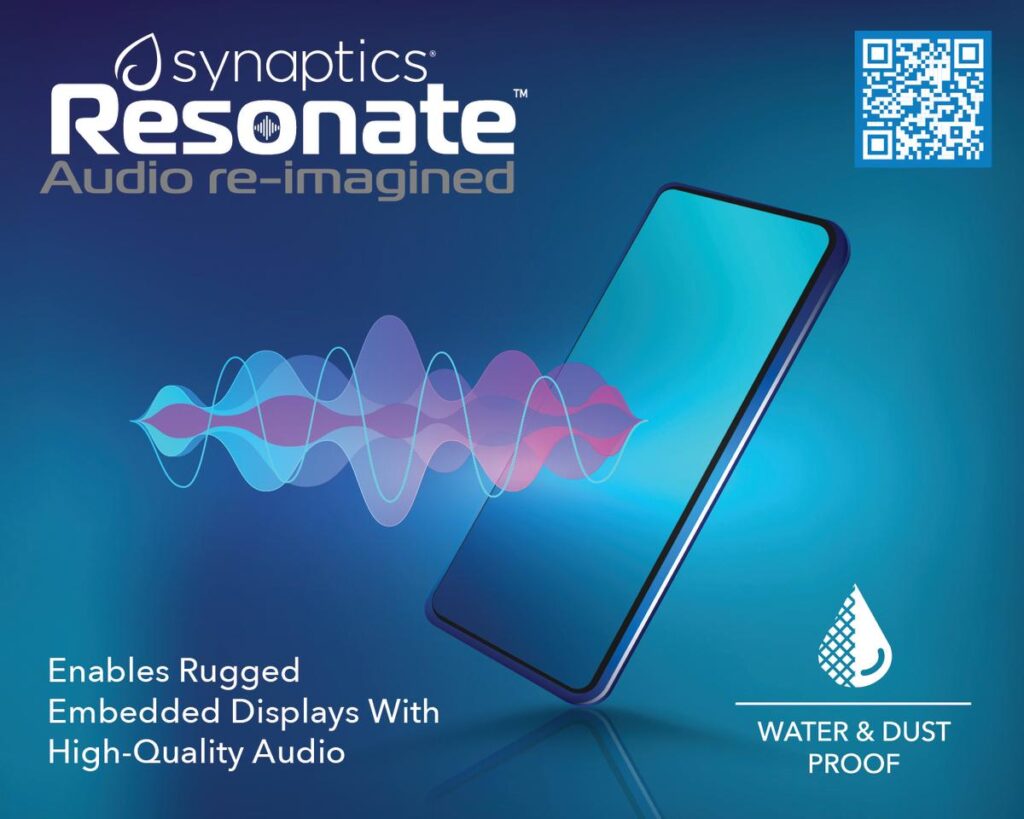
 Synaptics Incorporated announced Synaptics Resonate, a game-changing solution that uses a display’s surface as a sound and haptics transducer to provide a more immersive audio and interactive user experience while reducing space, cost, and power consumption for Internet of things (IoT) devices. The innovative technology enables slim, bezel-less, and inherently dustproof and waterproof designs. This allows developers to bring the benefits of Synaptics Resonate to industrial, automotive, and consumer electronics applications such as TVs, smart appliances, portable media players, toys and gaming platforms, smartphones, automotive displays, monitors, and laptops.
Synaptics Resonate replaces the dynamic speakers and linear resonant actuators (LRAs) typically used for audio and haptic feedback, respectively, with piezoelectric transducers placed on the rear of the display glass. These are driven by a proprietary amplifier and algorithms such that the audio emanates directly from the surface of the glass to provide a line-of-sight, immersive viewing experience with a high sound pressure level (SPL) and excellent audio fidelity. The design avoids the compromises of side-or down-firing speakers, a consequence of modern, thin industrial design trends.
The same transducers produce the haptic feedback, resulting in more contextually relevant, dynamic haptic engagement for gaming and more precise system control applications. As the transducers are piezoelectric, they can also be used to detect pressure for a third axis of control for touch interfaces. These combine to provide a crisper, more responsive, and more intuitive interactive experience for the end user.
Key features and benefits include: Integrated IoT display, audio, and haptics for ease of implementation in a slim, bezel-less design with reduced system cost and a smaller footprint; Up to 80% greater power efficiency compared to micro speaker designs; Line-of-sight audio for a more immersive viewing experience, with excellent loudness and fidelity; Dynamic haptic capability for contextual feedback in gaming and other applications; Pressure sensing for a third axis of control for touch interfaces; Eliminates audio ports to enable more elegant and environmentally protected designs; Synaptics Resonate can be applied to any surface to turn it into a smart surface with audio, haptics, and touch pressure sensing;