Automotive Ethernet is a physical layer standard that adapts standard Ethernet technology to the specific demands of the electric vehicle (EV) environment. This article examines how AE is evolving in-vehicle networking to meet the high-bandwidth, reliability, and architectural requirements of next-generation connected and autonomous vehicles.
Networks, such as Controller Area Network (CAN) and Local Interconnect Network (LIN), have supported the industry for many years. However, the data transmission requirements of EVs and automated driving systems exceed the capabilities of these legacy buses. Therefore, automotive Ethernet provides the necessary architecture for future in-vehicle networks (IVNs).
Sensor fusion and data requirements
The need for greater vehicle autonomy is driving the adoption of Automotive Ethernet. Advanced driver assistance systems (ADAS) and automated driving utilize a wide variety of sensors. EVs typically integrate high-resolution video cameras, LiDAR, long-range radar, and ultrasonic sensors.
These sensors generate high-bandwidth data streams, often exceeding 1 Gbps per sensor. To process this information for functions such as pedestrian detection and object avoidance, the IVN must support bandwidths beyond what traditional buses offer. Automotive Ethernet handles these data loads, facilitating the transmission of environmental data to the central compute unit with minimal latency.
Why is a specific automotive standard necessary when standard Ethernet is already available?
Standard Ethernet used in IT environments is not designed for automotive conditions, which include temperature fluctuations, mechanical vibrations, and electromagnetic interference. Automotive Ethernet addresses these factors through standardized automotive-grade Physical layers (PHYs) designed for operation in this environment.
Current standards provide various data rates to support specific zonal requirements, including 100BASE-T1 (100 Mbps), 1000BASE-T1 (1 Gbps), and Multi-Gig (2.5, 5, and 10 Gbps).
A distinct feature of Automotive Ethernet is its physical connectivity. While standard Ethernet (100BASE-TX) uses two twisted pairs of cables for 100 Mbps, Automotive Ethernet (100BASE-T1) achieves full-duplex communication at the same speed using a single unshielded twisted pair.
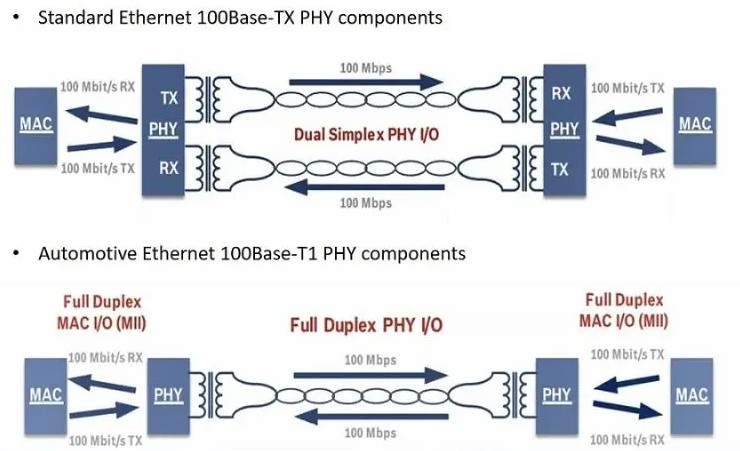
As shown in Figure 1, this single-pair configuration offers advantages in weight and space. The wiring harness is a significant component of vehicle weight and cost. Adopting automotive Ethernet enables engineers to reduce cabling weight and diameter, thereby contributing to the efficiency and manufacturing of EVs.
Is high bandwidth sufficient to ensure vehicle safety?
Automotive applications require deterministic communication to ensure messages arrive within a stipulated time. To address the best-effort nature of standard Ethernet, the industry utilizes the Time-Sensitive Networking (TSN) family of standards (IEEE 802.1).
Key TSN standards include:
- IEEE 802.1Qbv: Sets up transmission gates to plan traffic for frames that need to be sent quickly.
- IEEE 802.1Qbu / 802.3br: This feature allows high-priority frames to be transmitted before standard frames, reducing latency for critical data.
- IEEE 802.1CB (FRER): Replication of frames across different paths improves reliability.
- IEEE 802.1AS-2020: Provides synchronized timing across Electronic Control Units (ECUs), which is necessary for correlating sensor data.
Automotive Ethernet also supports the standard TCP/IP stack, enabling the use of upper-layer protocols.
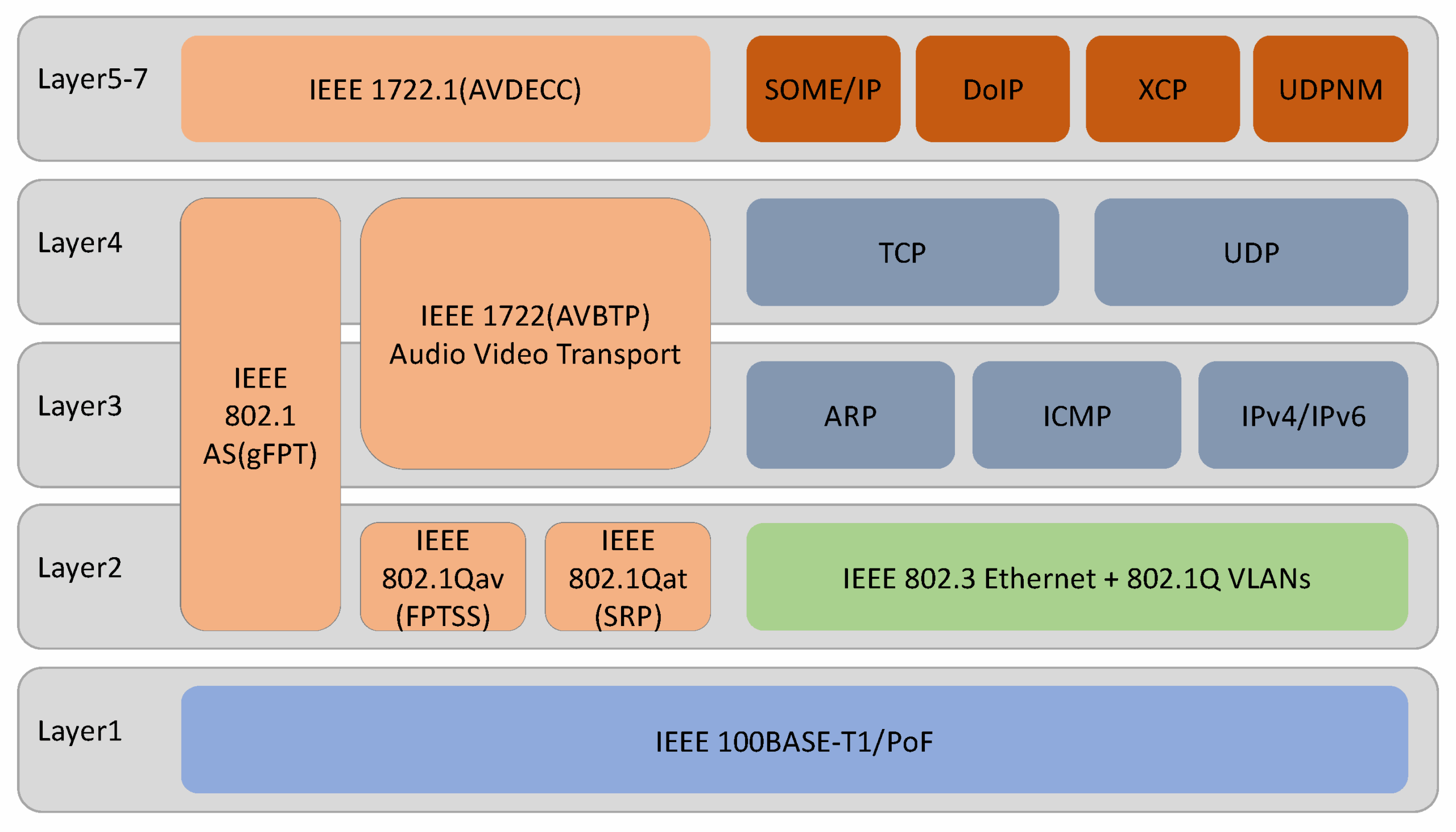
Figure 2 illustrates the protocol architecture, which supports SOME/IP (Scalable Service-Oriented Middleware over IP) for service-based ECU communication and DoIP (Diagnostic communication over Internet Protocol). DoIP enhances maintenance processes by enabling the parallel reprogramming of ECUs at higher speeds than legacy interfaces.
How does this connectivity impact the physical architecture of the vehicle?
Automotive Ethernet facilitates a shift in vehicle network architecture. Traditional networks often employ a domain-based architecture, where ECUs connect based on their functions. This approach results in complex cross-car cabling. Automotive Ethernet supports the transition to a Zonal Architecture, where wiring is organized by physical location. Zonal Gateways manage devices within a specific area of the vehicle, regardless of their function.
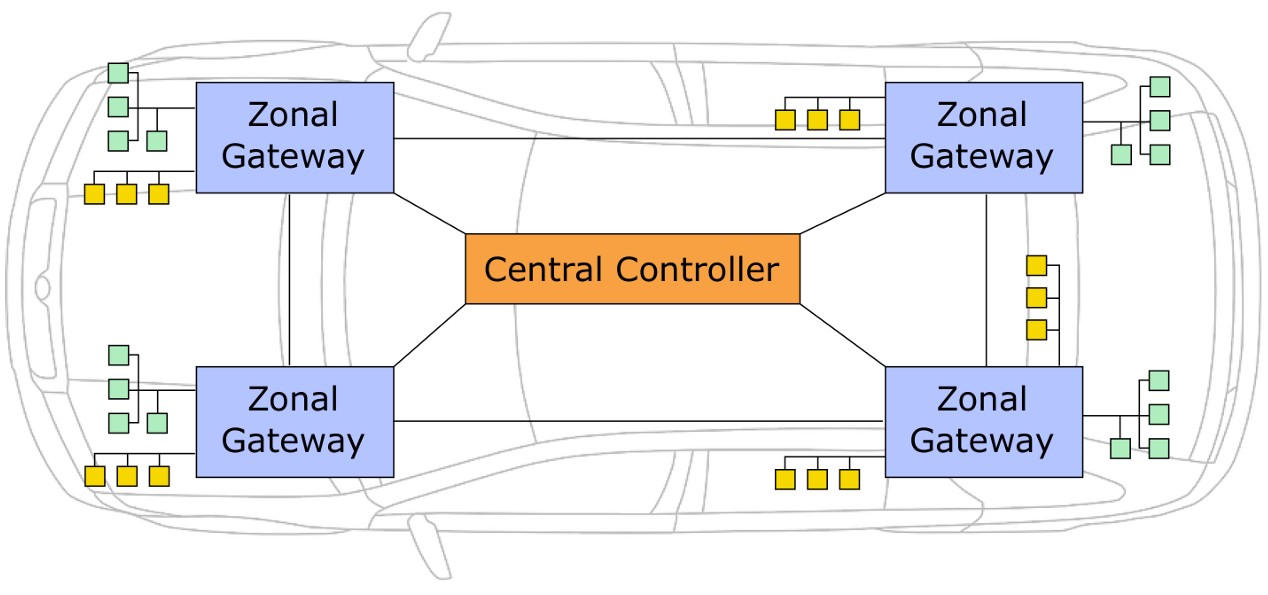
Figure 3 depicts this topology. A high-speed Ethernet backbone, usually 10 Gbps or higher, connects these Zonal Gateways to a central high-performance computer. The Zonal Gateways translate data between the Ethernet backbone and legacy local buses (CAN/LIN) connected to edge sensors. This structure simplifies the wiring harness, reduces weight, and supports a scalable software-defined platform.
Summary
Software-defined vehicle development is made possible by automotive Ethernet, which facilitates the switch from domain-based to zonal designs and offers deterministic performance via TSN. Automotive Ethernet establishes the necessary network infrastructure for autonomous systems with numerous sensors. Due to this scalable architecture, automotive engineers can design EVs that can meet the data processing and safety demands of emerging mobility solutions.
References
A Perspective on Ethernet in Automotive Communications—Current Status and Future Trends, Applied Science, MDPI
Design of a CANFD to SOME/IP Gateway Considering Security for In-Vehicle Networks, Sensors, MDPI
Automotive Ethernet: The In-Vehicle Networking of the Future, Keysight
IEEE 802 Ethernet Networks for Automotive, IEEE
EE World related content
Smarter, safer, cheaper: How Ethernet will enable the car of the future
How zonal automotive power distribution can improve efficiency
Ethernet turned 50 in 2023, what’s next? – 5G Technology World
What is the ideal Ethernet choice for automotive applications?
10Base-T1S simplifies automotive zonal architectures
How do EVs benefit from using zonal architectures?






Leave a Reply