This second part of the FAQ series will cover Bluetooth modules from Texas Instruments and Quectel, focusing on ARM processors. Despite having a common processor with different processing speeds, these modules have unique features that make them suitable for different IoT applications.
Texas Instruments: CC2745R-Q1
The CC2745R-Q1 Bluetooth module from Texas Instruments features a powerful 96 MHz Arm Cortex-M33 for real-time sensor data processing, wireless communications, and complex algorithms. The inclusion of an FPU (floating-point unit) provides faster decimal number processing than software implementation. Figure 1 shows a block diagram of the Bluetooth module’s features.
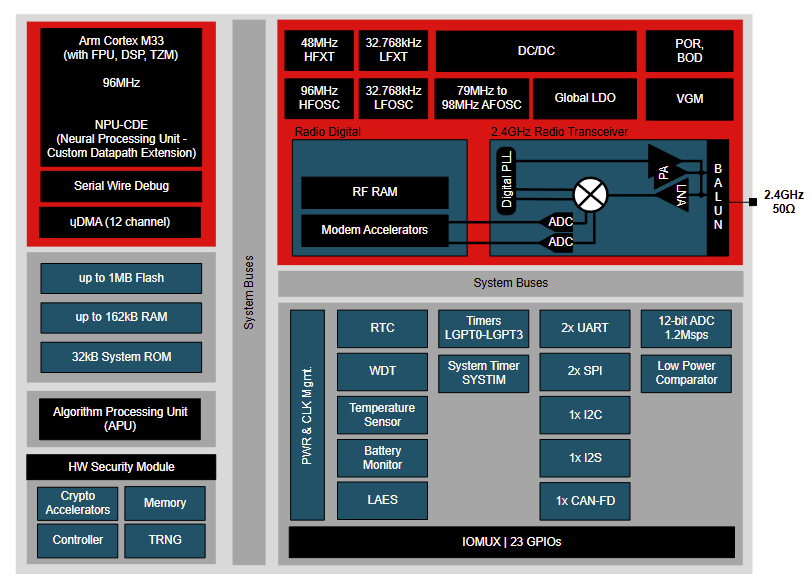
The module supports CDE (custom datapath extension), which improves performance gains by allowing custom instructions to accelerate specific functions with fewer instructions. The Algorithm Processing Unit (APU) accelerates complex computational tasks at 96 MHz, reducing processing time and energy consumption.
The large flash memory (1 MB) enables storage of complex firmware and multiple protocol stacks and supports over-the-air (OTA) software updates. An extensive SRAM (162 KB) supports complex real-time processing tasks.
The module’s Bluetooth 5.4 offers improved data transfer capabilities, enhanced power efficiency, and extended transmission range and signal coverage. Bluetooth Channel Sounding offers precise distance measurement and enhanced security, providing centimeter-level accuracy in proximity detection.
The CC2745R-Q1 is part of the SimpleLink MCU, simplifying software development with a single-core software development kit (SDK). This feature is affordable, reduces manufacturing complexity, and quickly adapts to new wireless communication trends.
The device enables seamless integration across multiple wireless communication standards by providing a 2.4 GHz RF transceiver. The integrated BALUN and RF switch reduces external component requirements, minimizes board complexity, and enhances overall signal integrity.
The sensitivity level of -103.5 dBm ensures robust and reliable wireless communication even in challenging signal environments. The ultra-low standby current of 0.9 µA enables extended battery life support. The on-chip buck dc/dc converter provides precise voltage regulation and efficient power management to operate on limited power sources.
The device maintains a reasonable power draw during active communication phases, with a receiver current of 6.1 mA and a transmit current of 7.7 mA at 0 dBm. ISO21434 manages cybersecurity risks throughout a vehicle’s lifecycle. The Hardware Security Module and secure boot capabilities protect against cyber and physical attacks.
The AES-128 crypto accelerator is designed specifically for latency-critical link-layer encryption and ensures high-speed security operations. The Cortex-M33 TrustZone-M technology, combined with the Memory Protection Unit (MPU) and memory firewalls, provides software isolation. The voltage glitch monitor adds another layer of physical security by mitigating potential hardware-level attack attempts.

The module’s extensive peripheral support and GPIO options (UART, SPI, I2C) allow easy integration with sensors and actuators common in IoT devices. A junction temperature range of -40 °C to 125 °C enables deployment in extreme environmental conditions. A compact 6 mm × 6 mm QFN40 package with wettable flanks offers minimal board space.
It provides automotive access and security systems such as Phone as a Key (PaaK), Passive Entry Passive Start (PEPS), and Remote Keyless Entry (RKE) that enable seamless vehicle interactions using smartphones.
The LP-EM-CC2745R10-Q1 LaunchPad development kit, shown in Figure 2, has a 2.4 GHz radio for wireless applications with an integrated PCB trace antenna. The integrated power amplifier speeds up development, especially for automotive applications.
Quectel: HCM010S Bluetooth 5.4 Module
Figure 3 shows the HCM010S, a dedicated Bluetooth 5.4 module from Quectel. Its 80 MHz ARM Cortex-M33 processor provides the computing power to handle difficult IoT applications with minimal power consumption. The 64 KB of SRAM and 768 KB of flash memory offer sufficient space for IoT software and data processing.

BLE 5.4 support offers a better range than previous BLE versions and higher data throughput when needed for software updates. Bluetooth mesh networking allows the creation of large networks of IoT devices that can communicate with each other.
The HCM010S’s receiver sensitivity of about -104 dBm guarantees dependable connections even in challenging environments, such as through walls or industrial settings. The +20 dBm transmit power makes greater-range communication possible.
It supports up to 20 GPIOs for UART/SPI/I2C/I2S support and allows connection to various types of sensors, displays or indicators, microcontrollers, or systems. The QuecOpen solution provides a development platform that simplifies the creation and deployment of IoT applications, reducing time-to-market and development costs.
The Secure Vault feature protects sensitive data from unauthorized access and enables secure OTA updates. The HCM010S module’s hybrid Leadless Chip Carrier (LCC) and Dual In-Line Package (DIP) package format is compatible with diverse designs. It provides a good balance between size efficiency and ease of integration.
The wide operating temperature range (-40 °C to +105 °C) makes it suitable for outdoor and industrial applications in harsh environments. The built-in PCB antenna simplifies the design process and reduces implementation costs. This module utilizes mesh networking for coordinated control and is suitable for smart lighting, industrial IoT, building automation, and home automation applications.
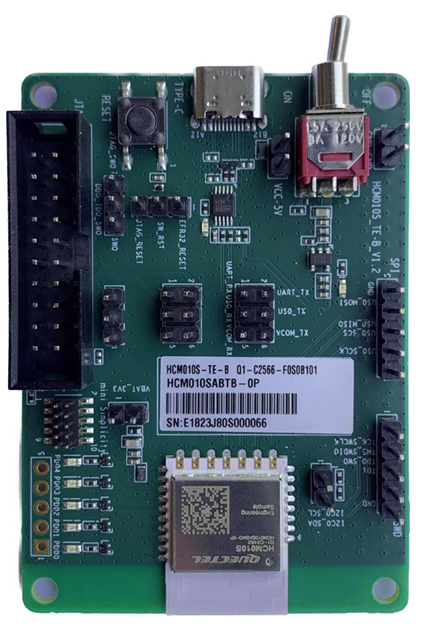
Figure 4 shows the HCM010S-TE-B, a Bluetooth development board that can be used to test basic functionalities and develop HCM010S. It comprises different interfaces, such as USB, Debug, and USART. The inbuilt status LEDs indicate the VBAT ON/OFF and USART status. The available test points can be used to test power consumption and the module’s basic function.
Summary
Texas Instruments’ CC2745R-Q1 and Quectel’s HCM010S work on the Arm Cortex-M33 processor, which has higher processing speeds. However, while CC2745R-Q1 has more flash memory and SRAM, HCM010S has more transmit power. CC2745R-Q1 is preferred for automotive applications, and HCM010S is preferred for smart lighting and smart buildings.
The next FAQ will cover Bluetooth modules from Feasycom and Microchip Technologies and their features and applications.
References
LP-EM-CC2745R10-Q1 Evaluation board, Texas Instruments
HCM010S TE-B User Guide, SOS electronics
CC274xR-Q1 datasheet, Texas Instruments
MCU Bluetooth HCM010S, Quectel
Related EE World Online content
Battery life analysis and maximization for wireless IoT sensor nodes and wearables
Power consumption testing for wireless IoT sensor nodes and wearables, Part 2
Power conversion considerations for wireless IoT nodes and wearables, Part 1
Wireless and MCUs: Bluetooth, Wi-Fi, or Zigbee?
Selecting the right Bluetooth Low Energy SoC
Bluetooth and the road to a keyless future



Leave a Reply