• Skip to primary navigation
  • Skip to main content
  • Skip to primary sidebar
  • Skip to footer

Microcontroller Tips

Microcontroller engineering resources, new microcontroller products and electronics engineering news

  • Products
    • 8-bit
    • 16-bit
    • 32-bit
    • 64-bit
  • Applications
    • 5G
    • Automotive
    • Connectivity
    • Consumer Electronics
    • EV Engineering
    • Industrial
    • IoT
    • Medical
    • Security
    • Telecommunications
    • Wearables
    • Wireless
  • Learn
    • eBooks / Tech Tips
    • EE Training Days
    • FAQs
    • Learning Center
    • Tech Toolboxes
    • Webinars/Digital Events
  • Resources
    • Design Guide Library
    • LEAP Awards
    • Podcasts
    • White Papers
  • Videos
    • EE Videos & Interviews
    • Teardown Videos
  • EE Forums
    • EDABoard.com
    • Electro-Tech-Online.com
  • Engineering Training Days
  • Advertise
  • Subscribe

Cloud connectivity in IoT, Part 1: How communication works

February 24, 2020 By Majeed Ahmad Leave a Comment

Cloud connectivity, a fundamental part of the majority of the Internet of Things (IoT) projects, is intertwined with expertise in embedded systems and software integration. That’s why MCU suppliers are working closely with cloud service providers to develop integrated hardware and software solutions that enable IoT developers to establish an edge-to-cloud connection using out-of-the-box solutions quickly and efficiently.

These collaborations take out most of the complexities in cloud-connected IoT deployments and thus significantly lower the barrier to entry for IoT solutions deployment. IoT developers, for instance, can connect development boards supplied by MCU vendors to cloud services like Google’s Cloud IoT Core and Amazon’s AWS IoT Core with a single click.
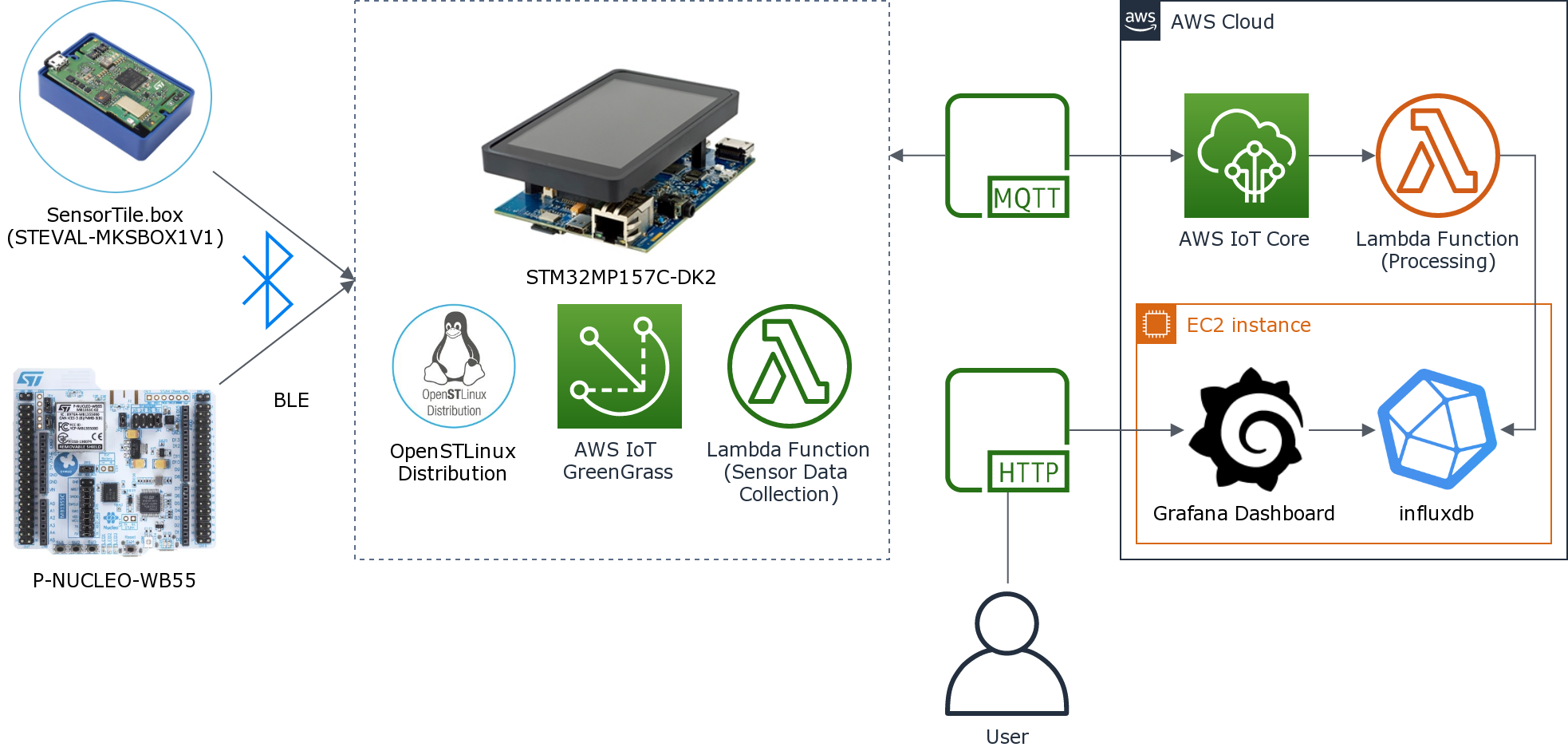
Figure 1: A view of an IoT node-to-cloud connection showing the hardware and software building blocks employed for an end-to-end IoT connection. (Image: STMicroelectronics)

Anatomy of cloud connection

But how does an IoT-to-cloud connection actually work? For a start, like every communication cannel, the link between an IoT device and the cloud service is established via wired or wireless communication networks such as Ethernet and Wi-Fi. Next, there are two common transport- and application-layer protocols that help facilitate communication between an IoT device and a cloud service.

At the transport-layer level, the device-to-cloud communication usually takes place either via Transmission Control Protocol (TCP) or User Datagram Protocol (UDP). Here, it’s important to note that though TCP takes more network overhead, it’s favored in IoT applications for its reliability. UDP, on the other hand, is more suitable for applications like video streaming that can afford some data packet loss.

Next, at the application-layer level, Hyper Text Transfer Protocol (HTTP) is the common standard to send connection requests and return responses for TCP-based communications. Message Queuing Telemetry Transport (MQTT) is another application-layer protocol; it’s lightweight with a small code footprint and is becoming popular in resource-constrained IoT devices.

The role of APIs

It’s a two-way data communication over the Internet between a device and a remote service. An IoT device establishes a connection with the Internet Protocol (IP) network and is subsequently hooked to the cloud. Here, support from MCU vendors ranges from the hardware level to the API stacks to facilitate IoT-to-cloud development.

The APIs are well defined, and they include open-source client libraries, example codes, and protocol stacks. Then there are third-party tools that make these APIs easier to use and deploy. So, all developers need to learn is how to use IoT device interfaces effectively; embedded designers who know how to use or leverage IoT device APIs are now in high demand.
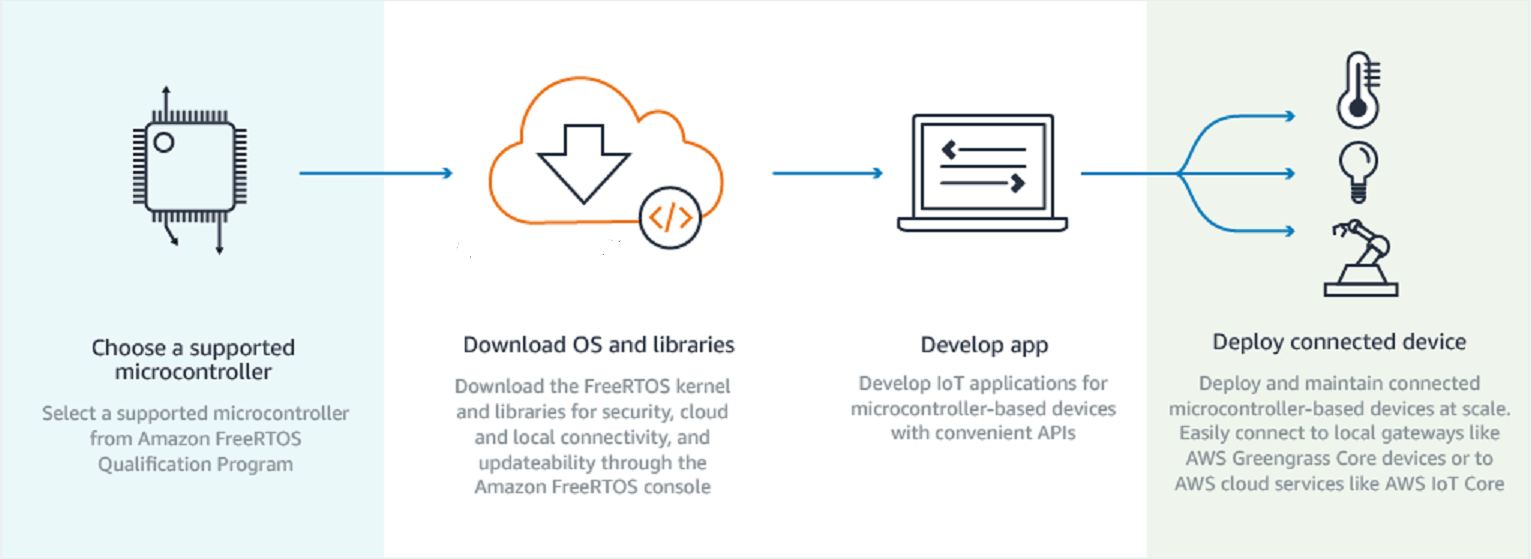
Figure 2: A step-by-step display of how an MCU-based IoT device can be connected to a cloud service like AWS IoT Core. (Image: CNX Software)

Take the example of how MCU suppliers are integrating software platforms like Amazon FreeRTOS into their microcontroller offerings (Figure 2). Amazon FreeRTOS is an open-source real-time operating system (RTOS) for microcontrollers that includes kernel and software libraries to connect small, low-power MCUs to Amazon’s cloud service AWS IoT Core.

The FreeRTOS-enabled microcontrollers can directly connect to a cloud service like AWS IoT Core, or they can connect to a local edge device such as AWS Greengrass and sustain the communications even if the IoT device loses connection to the cloud.


 

You may also like:

  • secure data links
    Cloud connectivity in IoT, Part 2: How to secure data…
  • zero touch positioning
    How zero-touch provisioning simplifies IoT links to cloud
  • IoT security
    How to tackle the tough stuff around IoT security –…

Filed Under: Applications, Connectivity, Embedded, FAQ, Featured, RTOS Tagged With: FAQ

Reader Interactions

Leave a Reply Cancel reply

Your email address will not be published. Required fields are marked *

Primary Sidebar

Featured Contributions

Can chiplets save the semiconductor supply chain?

Navigating the EU Cyber Resilience Act: a manufacturer’s perspective

The intelligent Edge: powering next-gen Edge AI applications

Engineering harmony: solving the multiprotocol puzzle in IoT device design

What’s slowing down Edge AI? It’s not compute, it’s data movement

More Featured Contributions

EE TECH TOOLBOX

“ee
Tech Toolbox: Connectivity
AI and high-performance computing demand interconnects that can handle massive data throughput without bottlenecks. This Tech Toolbox explores the connector technologies enabling ML systems, from high-speed board-to-board and PCIe interfaces to in-package optical interconnects and twin-axial assemblies.

EE Learning Center

EE Learning Center

EE ENGINEERING TRAINING DAYS

engineering
“bills
“microcontroller
EXPAND YOUR KNOWLEDGE AND STAY CONNECTED
Get the latest info on technologies, tools and strategies for EE professionals.

Footer

Microcontroller Tips

EE World Online Network

  • 5G Technology World
  • EE World Online
  • Engineers Garage
  • Analog IC Tips
  • Battery Power Tips
  • Connector Tips
  • EDA Board Forums
  • Electro Tech Online Forums
  • EV Engineering
  • Power Electronic Tips
  • Sensor Tips
  • Test and Measurement Tips

Microcontroller Tips

  • Subscribe to our newsletter
  • Advertise with us
  • Contact us
  • About us

Copyright © 2026 · WTWH Media LLC and its licensors. All rights reserved.
The material on this site may not be reproduced, distributed, transmitted, cached or otherwise used, except with the prior written permission of WTWH Media.

Privacy Policy