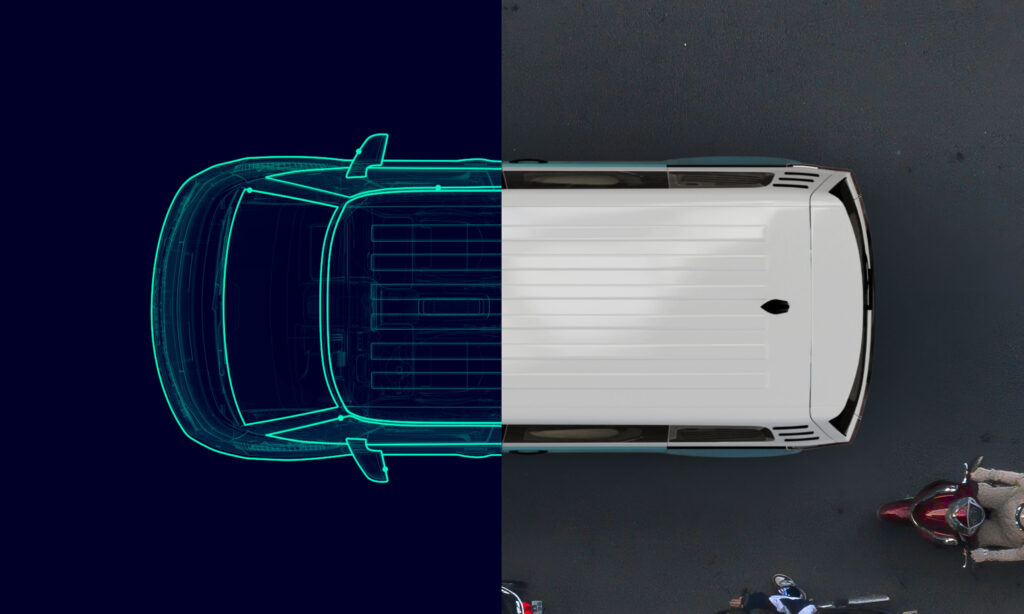
 Siemens’ new PAVE360 Automotive drives next-generation vehicle development with real-world validation
New off-the-shelf, cloud-based, digital twin offering, PAVE360 Automotive, empowers automakers and suppliers to begin full-system development on day one, reducing setup time from months to days
Delivers a fully integrated, system-level digital twin that speeds up development of advanced driver-assistance systems (ADAS), autonomous driving (AD), and in-vehicle infotainment (IVI) systems using the latest automotive technology from industry leaders like Arm
New PAVE360 Automotive digital twin blueprint to be demonstrated live for the first time at CES 2026
Today, Siemens, a leading industrial technology company, unveiled its PAVE360 Automotive technology, a new category of digital twin software that is pre-integrated and designed as an off-the-shelf offering to address the escalating complexity of automotive hardware and software integration.
PAVE360 Automotive empowers automotive manufacturers and suppliers to speed the development of software-defined vehicles (SDVs) with early full-system, virtual integration that mirrors real vehicle hardware and accelerates both application and low-level software development for ADAS, AD, and IVI. This removes the need for customers to build their own digital twins before testing software and significantly reduces time to market for critical applications, from months to days.
With vehicle hardware and software complexity rising at an unprecedented rate, development teams face mounting pressure to deliver innovation faster and compete with new market entrants while meeting increasingly sophisticated consumer expectations. Traditional development methodologies are no longer sufficient to manage system-level interdependencies between ADAS, AD, and IVI functions – a new approach is required.
PAVE360 Automotive leverages Siemens’ expertise in digital twin technology, empowering automakers to: Jumpstart vehicle systems development from the earliest phases with ADAS, AD, and IVI customizable virtual reference designs; Unify development, optimize efficiency, and increase cloud-based collaboration with a single digital twin for all teams; Customize and scale by adding software, models, and external hardware as needed
Speed up software development leveraging hardware-like simulation speed of the latest automotive IP, including the new Arm Zena Compute Subsystem (CSS)
Validate with real-world feedback by connecting digital twins to physical hardware and testing in real vehicles
System-level digital twins for SDVs using existing technologies can be complex and time-consuming to create and validate. To solve this bottleneck, PAVE360 Automotive delivers a fully integrated, system-level digital twin that can be deployed on day one – reducing the time, effort, and cost required to build such environments from scratch.
Following prior collaboration with Arm, which resulted in accelerated virtual environments for its Arm Cortex-A720AE in 2024 and Arm Zena Compute Subsystems (CSS) in 2025, Siemens is now further integrating Arm Zena CSS with PAVE360 Automotive to enable the industry to start building on Arm faster and more seamlessly than ever before. Access to Arm Zena CSS in a digital twin environment like PAVE360 Automotive accelerates the development of software by up to two years.
PAVE360 leverages Siemens’ Innexis software environment, combined with supporting technologies, to empower users to create system-level digital twins of ADAS, AD, and IVI capabilities. Siemens’ PAVE360 Automotive is available to key customers, with general availability in February 2026, and will be demonstrated live at CES 2026 in the Auto Hall, January 6–9, 2026. Attendees are invited to experience how Siemens is helping pioneers to deliver the future of automotive innovation. To learn more about Siemens’ PAVE360 Automotive, visit https://blogs.sw.siemens.com/pave360/2025/12/18/pave360-automotive-what-is-an-sdv-digital-twin-blueprint-and-why-do-you-need-one/



Leave a Reply