• Skip to primary navigation
  • Skip to main content
  • Skip to primary sidebar
  • Skip to footer

Microcontroller Tips

Microcontroller engineering resources, new microcontroller products and electronics engineering news

  • Products
    • 8-bit
    • 16-bit
    • 32-bit
    • 64-bit
  • Applications
    • 5G
    • Automotive
    • Connectivity
    • Consumer Electronics
    • EV Engineering
    • Industrial
    • IoT
    • Medical
    • Security
    • Telecommunications
    • Wearables
    • Wireless
  • Learn
    • eBooks / Tech Tips
    • EE Training Days
    • FAQs
    • Learning Center
    • Tech Toolboxes
    • Webinars/Digital Events
  • Resources
    • Design Guide Library
    • LEAP Awards
    • Podcasts
    • White Papers
  • Videos
    • EE Videos & Interviews
    • Teardown Videos
  • EE Forums
    • EDABoard.com
    • Electro-Tech-Online.com
  • Engineering Training Days
  • Advertise
  • Subscribe

Embedded FPGA IP works on 28-nm FD–SOI-based ICs

October 29, 2020 By Redding Traiger Leave a Comment

QuickLogic Corporation announced the availability of its ArcticPro 3 embedded FPGA (eFPGA) IP, which is now available on Samsung’s 28nm FD–SOI process, enabling OEMs and semiconductor companies to seamlessly integrate the capability of discrete FD-SOI FPGAs into their own ASICs/SoCs, greatly optimizing system performance, power consumption and cost for Edge AI use cases in consumer, IoT, and automotive applications.

QuickLogic’s ArcticPro 3 eFPGA IP has been designed from the ground up on the Samsung 28FDS process, resulting in a significant boost in performance and delivering ultra-low standby current leakage. The 28FDS process supports body biasing, enabling OEMs and semiconductor companies the ability to “dial-in” the ideal performance/power consumption parameters to meet their system requirements.

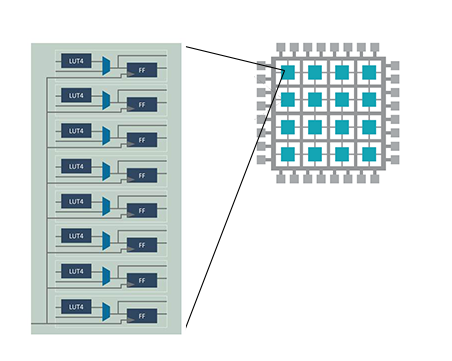
The ArcticPro 3 IP is developed with a homogenous, reprogrammable fabric architecture based on SLCs (Super Logic Cells), which consist of eight LUT4 + Register blocks, and it uses a hierarchical routing scheme that strikes the optimum performance and power consumption balance needed for computation heavy, battery-powered or other power-sensitive products. In addition to the logic fabric, the eFPGA IP includes the option to integrate fixed function blocks such as embedded RAM and fracturable Multiply-Accumulate (MAC) blocks to efficiently implement hardware accelerators for neural networks and other computationally intensive circuits foundational in AI/ML applications. ArcticPro 3 is supported by QuickLogic’s proprietary tools as well as the ground-breaking QuickLogic Open Reconfigurable Computing (QORC) vendor-supported open source FPGA development tools, giving designers full control over their system software development environment.

Over the past three decades, QuickLogic’s eFPGA IP has been implemented in numerous SoCs, MCUs, and discrete FPGAs, and shipped in millions of units into multiple end markets such as consumer, IoT, military, and industrial.

QuickLogic’s ArcticPro 3 eFPGA technology on Samsung’s 28nm FD–SOI process is available now.

You may also like:


  • Functional safety for embedded systems – Virtual Roundtable (part 2…

  • Security for embedded systems – Virtual Roundtable (part 1 of…
  • Embedded systems software and programming
    Embedded systems software and programming for a safer world

  • Securing embedded systems in a hostile world

  • Managing power consumption and dissipation in embedded systems for a…

Filed Under: Applications, Automotive, Consumer Electronics, Embedded, Industrial, IoT, Products, Software, Tools Tagged With: quicklogic

Reader Interactions

Leave a Reply Cancel reply

Your email address will not be published. Required fields are marked *

Primary Sidebar

Featured Contributions

Can chiplets save the semiconductor supply chain?

Navigating the EU Cyber Resilience Act: a manufacturer’s perspective

The intelligent Edge: powering next-gen Edge AI applications

Engineering harmony: solving the multiprotocol puzzle in IoT device design

What’s slowing down Edge AI? It’s not compute, it’s data movement

More Featured Contributions

EE TECH TOOLBOX

“ee
Tech Toolbox: Connectivity
AI and high-performance computing demand interconnects that can handle massive data throughput without bottlenecks. This Tech Toolbox explores the connector technologies enabling ML systems, from high-speed board-to-board and PCIe interfaces to in-package optical interconnects and twin-axial assemblies.

EE Learning Center

EE Learning Center

EE ENGINEERING TRAINING DAYS

engineering
“bills
“microcontroller
EXPAND YOUR KNOWLEDGE AND STAY CONNECTED
Get the latest info on technologies, tools and strategies for EE professionals.

Footer

Microcontroller Tips

EE World Online Network

  • 5G Technology World
  • EE World Online
  • Engineers Garage
  • Analog IC Tips
  • Battery Power Tips
  • Connector Tips
  • EDA Board Forums
  • Electro Tech Online Forums
  • EV Engineering
  • Power Electronic Tips
  • Sensor Tips
  • Test and Measurement Tips

Microcontroller Tips

  • Subscribe to our newsletter
  • Advertise with us
  • Contact us
  • About us

Copyright © 2026 · WTWH Media LLC and its licensors. All rights reserved.
The material on this site may not be reproduced, distributed, transmitted, cached or otherwise used, except with the prior written permission of WTWH Media.

Privacy Policy