
The jointly developed human-presence detection solution from Socionext and Innatera combines 60 GHz FMCW radar sensing with a neuromorphic Spiking Neural Processor to enable always-on detection at sub-milliwatt power levels. The system processes radar data directly at the edge to distinguish human from non-human motion, including stationary individuals, with reported accuracy above 99%, allowing connected […]
Artificial intelligence/ML
Edge AI applications include arc fault detection and condition monitoring

Microchip Technology has introduced full-stack edge AI solutions built around its microcontrollers and microprocessors to support real-time inferencing in industrial, automotive, data center and IoT applications. The platform integrates deployable pre-trained models, application code and development tools including MPLAB X IDE, MPLAB Harmony and the MPLAB ML Development Suite, enabling AI functions such as arc […]
COM Express 3.1 Type 6 Compact modules support -40 to +85 °C industrial temperature range
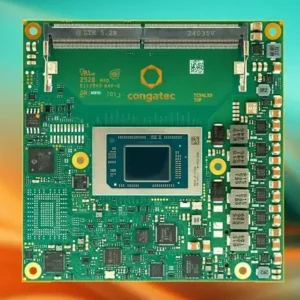
The conga-TCRP1 from congatec is a COM Express Type 6 Compact module built on AMD Ryzen™ AI Embedded P100 Series processors, combining up to 6 Zen5/Zen5c CPU cores, a Radeon™ RDNA™ 3.5 GPU and an XDNA2 NPU delivering up to 50 TOPS for edge AI workloads. The module supports up to 96 GB DDR5-5600 memory […]
What are the benefits of RISC-V in AI, ML, and embedded systems?
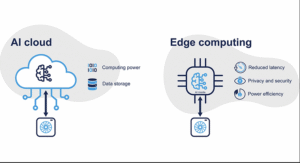
The open-source nature of RISC-V brings the benefits of a modular and royalty-free instruction set architecture (ISA) that eliminates licensing fees, can accelerate development, and fosters customization for diverse applications, including artificial intelligence (AI), machine learning (ML), the Internet of Things (IoT), and embedded systems. Automation levels are being increased in many types of applications, […]
How is physical artificial intelligence used to optimize data center efficiency?

Physical AI (PAI) in data center power systems uses machine learning for predictive maintenance, energy optimization, load balancing, and physical security. In essence, PAI is being used for data center optimization to support the demands of digital AI (DAI) applications like training large language models (LLMs), running inference for real-time applications, and supporting infrastructure like […]
Next-gen DSP boosts AI and audio processing on power-limited SoCs

The Tensilica HiFi iQ DSP from Cadence is a sixth-generation audio and voice DSP IP based on a new architecture designed for AI-enhanced audio processing in edge devices. The DSP delivers higher compute density and energy efficiency than prior HiFi cores, with support for AI data types such as FP8 and BF16, enhanced vectorization and […]
What is an AI governor and how does it relate to physical AI?

An AI governor is a framework, set of policies, or an oversight mechanism designed to ensure that the development and use of AI systems are ethical, safe, transparent, and compliant with legal and societal standards. The term can also refer to an actual piece of code or circuit (governor logic) used as a safety mechanism […]
Entry-level AI MCU enables low-power edge inference on one chip
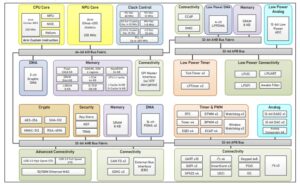
The NuMicro M55M1 AI MCU from Nuvoton Technology, developed in collaboration with the Industrial Technology Research Institute, integrates an Arm Cortex-M55 core with an Arm Ethos-U55 micro-NPU to deliver about 110 GOP/s for edge AI inference. The device includes up to 1.5 MB SRAM and 2 MB Flash with optional HyperRAM and HyperFlash expansion, enabling […]
How is physical AI used in autonomous and electric vehicles?

Physical AI (PAI) in autonomous and electric vehicles (EVs) involves systems that perceive the environment, make intelligent decisions, and execute appropriate actions in real-time, bridging the gap between digital intelligence and physical motion. PAI is autonomous, and electric vehicles can be used for several functions. Initially, it’s helping improve battery management and energy efficiency. In […]
Low-power LPDDR5X memory IP targets AI data centers

Cadence introduced an LPDDR5X memory IP system supporting data rates up to 9600 Mbps for enterprise and data center applications. The design combines LPDDR5X IP with symbol-based error correction to provide reliability comparable to DDR5 ECC while maintaining low power consumption and compact implementation. The subsystem supports 40-bit channels and sideband ECC to preserve bandwidth […]
